Few industries carry as many chokepoints as semiconductors. The value chain is complex, spanning intellectual property design, fabrication, manufacturing equipment, materials and memory. Each link plays a distinct role, and not all links are created equal.
Many of the high-flying stocks that now dominate benchmarks like the S&P 500 and Nasdaq-100 are designers. Companies such as Nvidia Corp. (ticker: NVDA) and Advanced Micro Devices Inc. (AMD) specialize in creating graphics processing units used in artificial intelligence applications.
“Semiconductors are the engine powering the AI revolution and the modern economy,” says Mo Sparks, chief product officer at Direxion. “Be it through trillion-dollar market caps, earnings surprises and misses, tariffs, or broader geopolitical events, today’s traders have plenty of catalysts to guide their conviction.”
The economic moat for these companies lies in intellectual property, software ecosystems and the pace of innovation. Their fortunes rise and fall based on product cycles, data center demand and how quickly they can out-design competitors.
“The semiconductor industry is undergoing its biggest shift in decades,” says Tejas Dessai, director of thematic research at Global X ETFs. “AI is reshaping computing, creating demand for specialized hardware while displacing legacy components.”
Yet the true bottlenecks in semiconductors sit elsewhere. One notable example is ASML Holding NV (ASML)。 This Dutch company produces the extreme ultraviolet lithography machines used to etch advanced chips at the smallest nanometer nodes.
These machines are extraordinarily complex, cost hundreds of millions of dollars each and are effectively irreplaceable for cutting-edge chip production, giving ASML a near-monopoly in this niche. In particular, export controls on this equipment have become a central geopolitical lever because without ASML’s tools, the most advanced chips simply cannot be made.
The other bottleneck lies in semiconductor fabrication. Taiwan Semiconductor Manufacturing Co. Ltd. (TSM), the dominant pure-play foundry, manufactures chips designed by companies around the world.
While firms such as Samsung Electronics Co Ltd. (005930.KS) and Intel Corp. (INTC) operate fabs, TSMC remains the unrivaled leader in producing the most advanced high-performance chips at scale. That dynamic adds geopolitical risk, particularly given tensions surrounding Taiwan’s sovereignty.
As an investor, you can therefore own designers betting on AI-driven demand, equipment makers controlling critical tools, foundries that manufacture the chips or even more specialized segments like memory. However, investors can also take a step back and gain more diversified exposure across the ecosystem through a semiconductor exchange-traded fund (ETF)。
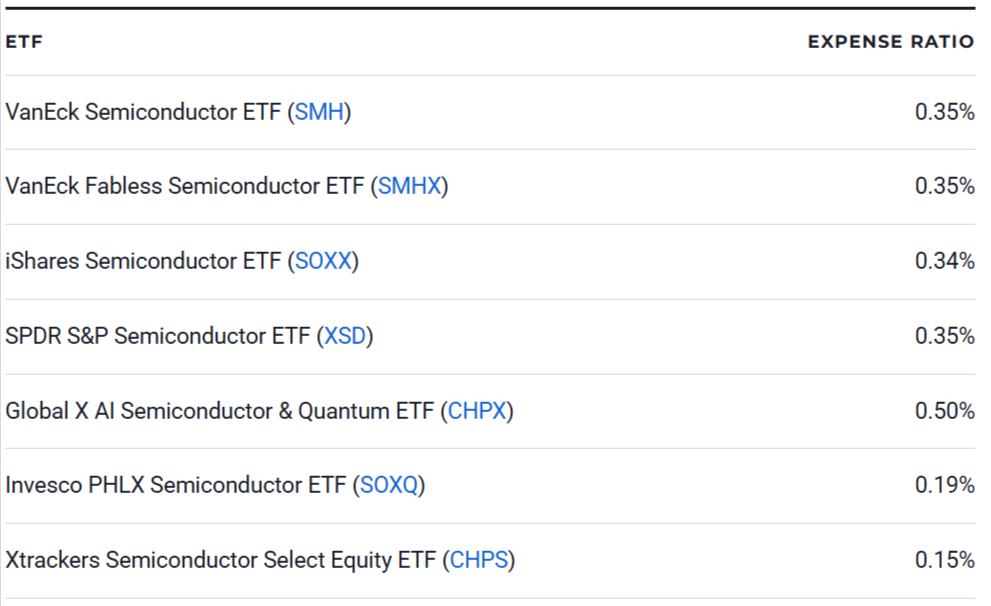
Here are seven of the best semiconductor ETFs to buy for 2026:
ETF
VanEck Semiconductor ETF (SMH)
VanEck Fabless Semiconductor ETF (SMHX)
iShares Semiconductor ETF (SOXX)
SPDR S&P Semiconductor ETF (XSD)
Global X AI Semiconductor & Quantum ETF (CHPX)
Invesco PHLX Semiconductor ETF (SOXQ)
Xtrackers Semiconductor Select Equity ETF (CHPS)
VanEck Semiconductor ETF (SMH)
“Semiconductors continue to be a cornerstone for innovation, especially as AI models grow more powerful,” says Nick Frasse, product manager at VanEck. “We’re closely watching compute and scaling laws – the trend of continuously increasing processing power – which strongly supports sustained semiconductor demand.” VanEck offers SMH, which tracks the MVIS US Listed Semiconductor 25 Index.
This ETF features a top-heavy portfolio, with Nvidia sitting at the top with an 18.2% weight followed by TSMC at 11.2%. However, this concentration has historically paid off for early investors, with SMH recording a 33.3% annualized total return over the trailing 10-year period. The ETF charges a 0.35% expense ratio, which works out to around $35 in fee drag every year assuming a $10,000 investment.
VanEck Fabless Semiconductor ETF (SMHX)
“The semiconductor industry continues to evolve rapidly, driven by fabless companies that prioritize chip design and innovation while outsourcing production,” Frasse notes. “This model allows firms like Nvidia to invest heavily in research and development, keep capital expenditures lower, and remain more agile as market conditions change.” Investors interested in targeting fabless firms may prefer SMHX over SMH.
SMHX’s portfolio does not include TSMC or ASML. In the event of escalating conflicts or increasing export controls, their absence may reduce risk for investors. “Geopolitical tensions and tariffs have made semiconductor supply chains more complicated, driving companies toward diversifying and localizing manufacturing,” Frasse explains. SMHX also charges a 0.35% expense ratio.
iShares Semiconductor ETF (SOXX)
“The potential benefits of investing in semiconductor ETFs include exposure to a high-growth industry with strong fundamentals, diversification across multiple companies in the industry and the potential for long-term capital appreciation,” says Sean August, CEO of the August Wealth Management Group. Investors preferring a less top-heavy yet still growth-tilted alternative to SMH pay prefer SOXX.
This ETF charges a lower expense ratio than SMH, and it tracks the NYSE Semiconductor Index instead. Micron Technology Inc. (MU) is currently the top holding at 8.5%, followed by Applied Materials Inc. (AMAT) and Nvidia at 6.9% each, and AMD at 6.4%. Historical total returns have also been competitive but lower than SMH, at 27.3% annualized over the trailing 10-year period.
SPDR S&P Semiconductor ETF (XSD)
“When looking for semiconductor ETFs, investors should consider factors such as the expense ratio, the underlying index or benchmark, the fund’s holdings and diversification strategy, and the ETF’s historical performance,” August says. “It is also important to assess the fund’s liquidity to ensure that it is easy to buy and sell.” To reduce concentration risk further without sacrificing fees or liquidity, consider XSD.
This ETF tracks the S&P Semiconductor Select Industry Index, an equal-weighted benchmark of approximately 40 large-, mid- and small-cap semiconductor stocks. However, the equal-weighting strategy has historically capped momentum for high-performing semiconductor stocks, with XSD lagging over the last decade with a 24.3% annualized total return. The ETF also charges a 0.35% expense ratio.
Global X AI Semiconductor & Quantum ETF (CHPX)
“The semiconductor shift is most visible on three fronts: the transition from general-purpose processors to AI-optimized chips, the use of high-bandwidth memory to handle AI’s data intensity and the rise of ultra-fast interconnect solutions that bind AI servers together,” Dessai explains. Global X’s newest thematic ETF, CHPX, is designed to capture these trends for a 0.5% expense ratio.
“CHPX provides exposure to companies across the entire global compute stack, from AI semiconductors to data center equipment, power infrastructure and quantum technologies,” Dessai says. “This offers a more holistic view of the long-term computing ecosystem rather than a narrow slice of it.” The two largest holdings in CHPX are currently ASML and TSMC at 11.9% and 11.3%, respectively.
Invesco PHLX Semiconductor ETF (SOXQ)
“While certain segments of the semiconductor market, like memory, may be facing pressure due to supply concerns, the longer-term growth potential driven by advancements in AI, autonomous driving and high-performance computing remains strong,” says Rene Reyna, head of thematic and specialty product strategy at Invesco. SOXQ undercuts SMH, SOXX and XSD with a lower 0.19% expense ratio.
This ETF tracks the PHLX Semiconductor Sector Index, a benchmark of the 30 largest U.S.-listed semiconductor firms. Each September, PHLX’s benchmark will reconstitute to add or drop holdings, while rebalances occur quarterly in March, June, September and December. SOXQ is newer than SOXX and SMH, but it has delivered a strong 41% annualized total return over the last three years.
Xtrackers Semiconductor Select Equity ETF (CHPS)
Even cheaper than SOXQ, CHPS tracks the Solactive Semiconductor ESG Screened Index for a 0.15% expense ratio. While not a strict sustainability fund, it incorporates environmental, social and governance screens that exclude certain controversial business activities, and applies risk-based scoring that traditional semiconductor benchmarks do not. That results in a noticeably different portfolio.
Although CHPS still owns many of the familiar industry names, the weightings diverge meaningfully from more top-heavy funds like SMH or SOXX. The ETF is far more evenly distributed. CHPS’ current top holdings are Texas Instruments Inc. (TXN), Applied Materials and Micron, each sitting at around 4.9% of assets. This provides more balanced exposure across analog, equipment and memory segments.
