Growth investing has always had a certain allure. The idea of riding on the financial coattails of companies that could shape the future sounds great on paper. But in today’s market, “growth” can mean many different things.
“The biggest mistake is assuming all growth ETFs offer the same exposure,” says Jay Jacobs, BlackRock’s U.S. head of equity ETFs. Different index providers define growth in different ways, and those definitions can meaningfully shape performance over time.
Some funds concentrate heavily in mega-cap leaders, like the Vanguard Mega Cap Growth ETF (ticker: MGK), while others spread exposure more evenly. Some serve as core building blocks for a portfolio, while others are better suited as targeted plays on specific trends like artificial intelligence or semiconductors, such as the VanEck Semiconductor ETF (SMH)。
“The market is more concentrated today – particularly within mega-cap growth – than at many points in the past,” Jacobs says. But that isn’t necessarily a bad thing. The concentration “is largely the result of fundamentals,” including strong earnings growth and dominant market positions, he says.
That raises an important question for investors: Should you lean into that concentration, or look for growth exchange-traded funds that diversify beyond it?
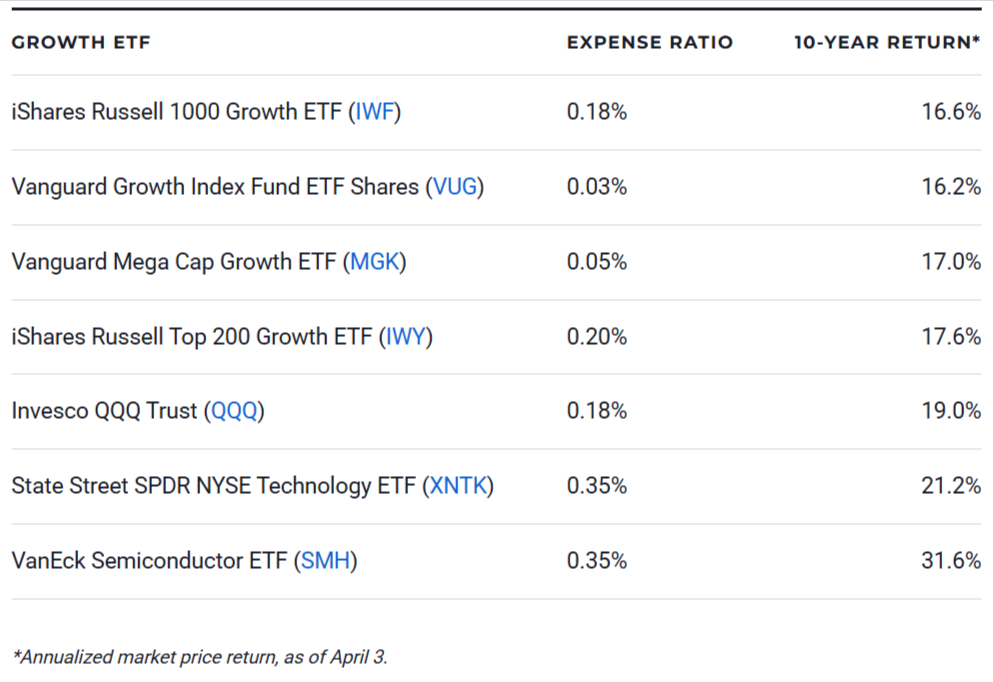
The answer depends on how you define growth in the first place. From broad, low-cost index funds to more targeted strategies tied to momentum or sectors like semiconductors, today’s growth ETFs offer a range of ways to participate in market leadership. Here are seven top growth ETFs for each flavor of growth investor:
Growth ETF
iShares Russell 1000 Growth ETF (IWF)
Vanguard Growth Index Fund ETF Shares (VUG)
Vanguard Mega Cap Growth ETF (MGK)
iShares Russell Top 200 Growth ETF (IWY)
Invesco QQQ Trust (QQQ)
State Street SPDR NYSE Technology ETF (XNTK)
VanEck Semiconductor ETF (SMH)
iShares Russell 1000 Growth ETF (IWF)
Kicking off this list of the best growth ETFs is one designed to “deliver growth in a way that’s both familiar and easy to use in portfolio construction,” Jacobs says. It tracks the widely used Russell 1000 Index, which measures the performance of roughly 1,000 of the largest stocks in the Russell 3000 Index.
Tracking a common benchmark is “important because investors often use these indexes as their starting point for U.S. equity exposure,” Jacobs says. As a result, IWF pairs nicely with value funds to help you “rebuild the market with a deliberate style tilt, adjusting between growth and value depending on their outlook and current environment.”
IWF also comes with the reassurance of strong liquidity: About 3.3 million shares trade hands daily, on average, and the fund boasts $113 billion in assets. So if and when you decide to sell, you should have no trouble getting the fair market price.
Vanguard Growth Index Fund ETF Shares (VUG)
Another strong contender for a core growth holding is VUG, particularly if you’re after broad exposure without overcomplicating things. The fund tracks a large-cap growth index that gives you access to many of the same market leaders driving returns today – think technology and consumer-focused companies with strong earnings momentum – but at a fraction of the cost of many competitors.
That cost advantage is where VUG really stands out. With an expense ratio around 0.03%, it’s one of the cheapest ways to access growth stocks. And while a few basis points might not seem like much, fees compound over time just like returns do, quietly eroding performance year after year. Keeping costs low can make a meaningful difference over a long investment horizon.
VUG also benefits from Vanguard’s straightforward indexing approach. Rather than making concentrated bets, it provides diversified exposure to growth companies across nearly all market sectors. This makes it a reliable option for a long-term portfolio.
Vanguard Mega Cap Growth ETF (MGK)
For a slightly more concentrated approach, consider MGK, which narrows the focus to the largest of the largest companies on the market. Mega-cap stocks are companies with market capitalizations of $200 billion or more. MGK holds 60 of these behemoths, with a weighted median market cap in the fund of $1.6 trillion (due to the dominance of the largest tech companies)。
That relative concentration is both the appeal and the trade-off for investors in MGK. By focusing on the biggest growth companies, the fund offers more direct exposure to firms with strong earnings and free cash flow. They’re often the same ones benefiting from major trends like AI and digital transformation, such as Nvidia Corp. (NVDA), Apple Inc. (AAPL) and Microsoft Corp. (MSFT)。 Those three account for nearly 35% of the whole portfolio.
But the reliance on a smaller group of stocks can amplify both gains and volatility. For instance, while the fund returned a whopping 51.7% in 2023, this came on the heels of a -33.6% slide in 2022.
Even with a more targeted approach, MGK maintains Vanguard’s hallmark low-cost structure with an expense ratio of only 0.05%. That’s a major boon for long-term investors and can make MGK a great complement to broader growth holdings.
iShares Russell Top 200 Growth ETF (IWY)
If you want to lean into mega-cap-driven growth without going quite as narrow as MGK, IWY may be for you. The fund focuses on the top 200 growth stocks in the Russell universe – although currently it holds only 110 of them. You’ll find many of the top names in other funds on this list. The top three holdings are Nvidia, Apple and Microsoft, which represent nearly 38% of the total portfolio.
This slightly broader mega-cap focus has translated into strong long-term returns with less volatility than MGK. For comparison, IWY gained 46.5% in 2023 after losing 29.9% in 2022. So this is by no means a smooth ride, but it can be a profitable one.
That said, it does carry a higher fee than MGK, with 0.2% in annual expenses. But this is still within reason for a targeted growth play.
Invesco QQQ Trust (QQQ)
The Invesco QQQ Trust is another well-known option in the growth ETF space. It tracks the Nasdaq-100 Index, which represents the 100 largest nonfinancial companies listed on the Nasdaq exchange. In other words, many of the same tech giants found elsewhere, such as Nvidia, Apple and Microsoft. But QQQ takes a more balanced approach with the top three names accounting for under 22% of the total portfolio and the top 10 names accounting for 47% of assets.
This tech focus has helped drive strong returns, but it also means performance can be closely tied to a relatively small group of mega-cap names. QQQ holds 101 stocks in total, and like MGK and IWY, it thrived in 2023 (nearly 55% annual return) after plummeting in 2022 (-32.6% annual performance)。
What truly sets QQQ apart is its liquidity. Around 63.4 million shares trade hands each day. And with $376 billion in assets, you can trust this fund is here to stay.
State Street SPDR NYSE Technology ETF (XNTK)
It’s no secret that tech is driving growth right now. So, why beat around the bush by targeting growth when you can get the same returns with tech alone?
XNTK offers a more balanced approach to tech-driven growth. Unlike market cap-weighted funds, which allocate assets based on the size of each company, XNTK uses an equal-weighted approach. This means all of its holdings represent roughly the same proportion of the fund, regardless of size. As a result, Apple is 2.8% of the fund and Micron Technology Inc. (MU) represents 4.6%.
That structure reduces the reliance on the biggest players while still letting investors ride key trends like AI, cloud computing and digital innovation. It also means you can get exposure to a broader range of companies that are poised to benefit as technology adoption continues to expand.
The biggest cautions here are expense and liquidity. At 0.35%, this isn’t the cheapest growth index fund. And less than 35,000 shares trade hands each day, which could increase the bid-ask spread. Still, if you want tech exposure without the mega-cap dominance, XNTK is a solid choice for a more diversified take on growth.
VanEck Semiconductor ETF (SMH)
For a more targeted and higher-octane approach to tech-driven growth, SMH zeroes in on one of the most critical parts of the modern economy: semiconductors. These companies sit at the center of trends like AI, cloud computing and data centers, making SMH a direct way to invest in the infrastructure powering technological growth.
The proof is in the performance pudding here: SMH has delivered an incredible average annual 10-year return of 31.6% as of April 3. Investors who owned shares throughout 2023 saw a huge 73.4% annual return. Of course, 2022 brought a -33.5% performance, so this isn’t a fund for the faint of heart.
These returns are heavily dependent on a handful of chipmakers. Nvidia represents over 19% of the portfolio, followed by Taiwan Semiconductor Manufacturing Co. Ltd. (TSM) at 11.7%. With a portfolio of only 25 stocks, the top 10 names claim 72% of total assets. So your fortunes are closely tied to those companies.
SMH also isn’t the cheapest fund on this list at a 0.35% annual expense. But if it continues to provide strong returns, the gains could easily make up for this higher fee.
