Energy stocks have long been viewed as a way to hedge against geopolitical instability, but current events around the Strait of Hormuz have reinforced just how quickly these dynamics can play out.
The conflict between the U.S. and Israel against Iran began more than three weeks ago, though President Donald Trump on March 23 said the two sides were negotiating a resolution to the conflict. Trump also postponed attacks on Iran’s energy infrastructure for five days.
However, Iranian officials disputed Trump’s claims about potential peace talks, and the Strait of Hormuz remains gridlocked. This narrow shipping lane is one of the most critical energy chokepoints in the world, with roughly one-fifth of global oil supply passing through it.
“Volatility tied to the Strait of Hormuz has reinforced the strategic importance of domestic energy infrastructure and supply chains,” explains Mark Marifian, head of product at Tortoise Capital. “With roughly 20 million barrels per day typically flowing through the Strait, recent disruptions have constrained flows by more than 90%.”
Analysts have also raised concerns about supply shortages, particularly for energy-import-dependent nations, as tensions escalate with tit-for-tat threats to Iranian power plants and retaliatory actions against U.S.-allied Persian Gulf nations.
The market reaction has been swift. As of March 22, Brent crude futures had climbed above $110 per barrel, while West Texas Intermediate crude hovered just below $100, though prices eased after Trump suggested the conflict could be coming to an end.
Commodity producers have been the clear beneficiaries, especially those operating outside the conflict zone, such as North American producers and midstream operators with exposure to the Permian Basin.
“In this environment, investors are increasingly recognizing that North American energy infrastructure provides both stability and income, even as global markets face a potential 15-to-16-million-barrel-per-day export deficit,” Marifian says. “The U.S. operates one of the most resilient and flexible energy systems in the world, with pipelines, storage and export capacity helping to insulate domestic markets.”
Year to date, the U.S. energy sector is up 31.8% on a price basis, far ahead of the next-best-performing consumer staples sector at 5.1%, while the broader market, as measured by the S&P 500, is down roughly 5%.
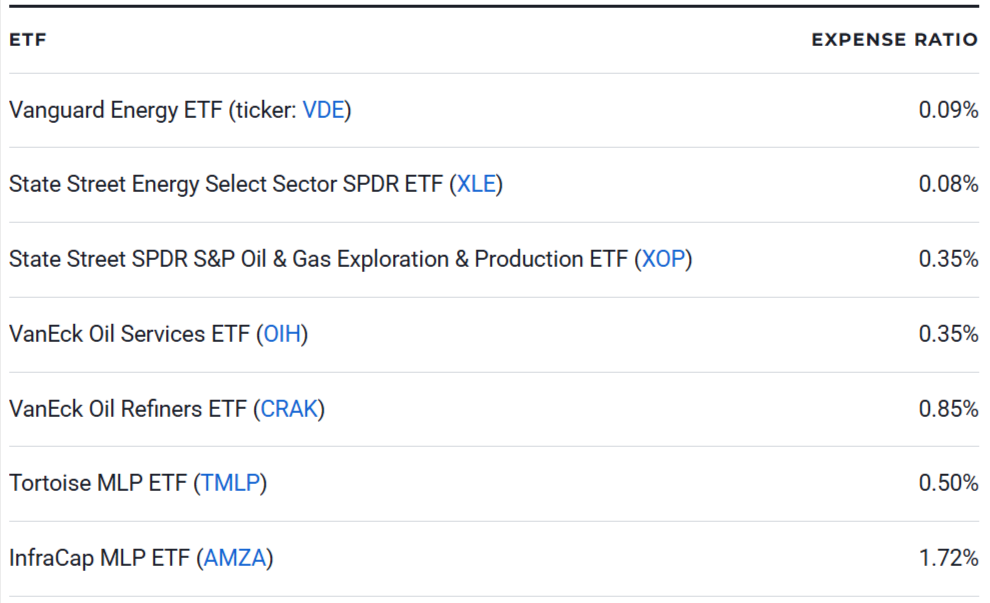
Here are seven of the best energy ETFs to buy in 2026:
ETF
Vanguard Energy ETF (ticker: VDE)
State Street Energy Select Sector SPDR ETF (XLE)
State Street SPDR S&P Oil & Gas Exploration & Production ETF (XOP)
VanEck Oil Services ETF (OIH)
VanEck Oil Refiners ETF (CRAK)
Tortoise MLP ETF (TMLP)
InfraCap MLP ETF (AMZA)
Vanguard Energy ETF (VDE)
“We prefer energy ETFs that are market capitalization-weighted versus equal-weighted,” says Adam Grossman, global equity chief investment officer at RiverFront Investment Group. “We prefer this because we believe larger companies will have better access to capital and are more likely to have diversified businesses at the margin.” VDE is one suitable ETF to express this view.
This energy ETF tracks a portfolio of 106 large-, mid- and small-cap companies represented by the MSCI US Investable Market Energy 25/50 Index. However, VDE’s two largest holdings, ExxonMobil Corp. (XOM) and Chevron Corp. (CVX), collectively account for just under 40% of the ETF’s weight. VDE pays a 2.4% 30-day SEC yield and charges a 0.09% expense ratio.
State Street Energy Select Sector SPDR ETF (XLE)
“Overlooked by investors, energy stocks were already gaining momentum before the Feb. 28 conflict started,” says Michael Arone, chief investment strategist and managing director at State Street Investment Management. “Expectations for a global cyclical upswing, combined with lighter regulation, disciplined capital spending, and ongoing innovation in exploration and production helped.”
XLE provides U.S. energy sector exposure at a 0.08% expense ratio, undercutting VDE by 0.01%. This ETF tracks the Energy Select Sector Index, a far narrower benchmark of 22 holdings selected from the S&P 500 index. Unlike VDE, XLE has no exposure to small-cap stocks, and it also has more stringent requirements for earnings, liquidity and size due to its S&P 500 roots. XLE pays a 2.5% 30-day SEC yield.
State Street SPDR S&P Oil & Gas Exploration & Production ETF (XOP)
“The most notable shift in earnings expectations over the past three weeks has been the continued upward revisions in the energy sector,” Arone explains. “After a decade of focusing on efficiency and doing more with less, energy companies are now beginning to benefit from what could be a meaningful increase in their revenue outlook.” This effect could particularly benefit energy explorers and producers.
That segment of the market can be accessed through XOP, which tracks the S&P Oil & Gas Exploration & Production Select Industry Index. The benchmark includes 50 equal-weighted companies focused on upstream activities. Compared to market cap-weighted funds like XLE and VDE, this structure results in greater exposure to mid- and small-cap companies. XOP charges a 0.35% expense ratio.
VanEck Oil Services ETF (OIH)
“OIH captures the oil services segment, which is directly leveraged to upstream capital spending and the ongoing need to sustain and grow global energy supply,” says Andrew Musgraves, vice president and senior product manager at VanEck. “Current geopolitical tensions involving Iran reinforce the importance of energy security, and are likely to support continued investment in exploration and production.”
OIH tracks a portfolio of 26 oil equipment, services and drilling companies represented by the MVIS US Listed Oil Services 25 Index. “Many of today’s new projects are increasingly complex – ranging from deepwater to unconventional resources – requiring advanced drilling, completion and subsea capabilities,” Musgraves says. The ETF charges a 0.35% expense ratio, the same as XOP.
VanEck Oil Refiners ETF (CRAK)
“CRAK isolates the refining segment, where margins are driven less by outright oil prices and more by product supply-demand dynamics and regional dislocations,” Musgraves says. “In the current environment – especially with renewed focus on the Strait of Hormuz – those dislocations can become more pronounced, tightening refined product markets even when crude is volatile.”
The 31 holdings in CRAK are responsible for refining petroleum into gasoline, diesel, jet fuel, fuel oil, naphtha and more. “We believe the current dynamic is constructive for crack spreads, particularly for complex refiners with access to discounted crude supplies,” Musgraves says. “With global refining capacity still relatively constrained, refiners remain one of the clearest ways to express that imbalance.”
Tortoise MLP ETF (TMLP)
“With global supply chains under pressure and futures markets reflecting elevated risk premiums, the importance of U.S. natural gas infrastructure and liquefied natural gas exports also continues to rise,” Marifian says. “The U.S. has emerged as a leading LNG supplier, leveraging its vast pipeline network and export capacity to deliver energy to global markets when it’s needed most.”
One way for retail investors to gain exposure to energy infrastructure is through master limited partnerships (MLPs)。 However, owning MLPs directly can complicate taxes, as they issue Schedule K-1 forms. TMLP offers a more efficient approach. Structured as a regulated investment company, it uses total return swaps for MLP exposure, and it issues a standard 1099-DIV form for taxes.
InfraCap MLP ETF (AMZA)
“The ongoing conflict with Iran solidifies the need for reliable U.S. LNG to supply international power demand,” says Jay D. Hatfield, founder, CEO and portfolio manager at Infrastructure Capital Advisors. “As of March 20, over the past few weeks, the price of natural gas in Japan and Europe relative to the U.S. has doubled to more than $15, with this spread representing the favorable economics of U.S. exports.”
Investors who are bullish on U.S. midstream infrastructure may find AMZA appealing. Unlike traditional MLP ETFs, AMZA has the flexibility to employ modest leverage, typically in the range of 20% to 30% of net asset value, and can use options strategies such as covered call writing. These features contribute to a pricier 1.72% expense ratio, but they also support a higher 6.8% 30-day SEC yield.
