Some of the most widely cited financial theories have been put to the test over the past decade, leading many investors to question their assumptions. One notable example is the three-factor model developed by Eugene Fama and Kenneth French.
Building on the earlier capital asset pricing model, their research introduced additional factors intended to better explain stock returns. Among the most prominent were size and value, which suggested that smaller companies and cheaper stocks historically produced higher long-term returns.
Over the past decade, however, those factors have struggled. From the 2008 financial crisis onward, mega-cap technology companies have dominated capitalization-weighted benchmarks like the S&P 500, pushing both market concentration and valuations to elevated levels.
Investors who tilted their portfolios toward small-cap stocks, value stocks or combinations such as small-cap value often lagged behind the broader market during this period. That performance gap has led some investors to question whether the traditional value premium still exists.
“Measuring value is not quite as simple as it was in the past,” says Thomas Cole, co-founder at Distillate Capital. “Ironically, after academia identified the premium associated with value in the early 1990s, the measure they most utilized to identify the cheapest stocks began to break down.”
Despite this debate, exchange-traded fund (ETF) providers have continued launching a growing number of value-focused strategies. Many of these have improved significantly compared with older value mutual funds, particularly in terms of fees and tax efficiency.
ETFs use an in-kind creation and redemption mechanism that allows portfolio managers to exchange securities directly with authorized participants to manage fund flows. All else being equal, this process helps lower taxable capital gains distributions for investors.
At the same time, index providers such as S&P Global, MSCI and Morningstar have refined their benchmarks to better capture value factor exposure. Approaches that once required complex quantitative models are now transparent and widely available for licensing to ETF providers.
“ETFs are a great way of gaining exposure to the value factor because it’s difficult to identify it,” says Anessa Custovic, chief investment officer at Cardinal Retirement Planning Inc. “You need a lot of fundamental data and intensive analysis to identify a potential value stock, and most retail investors don’t have the expertise or time to do this.”
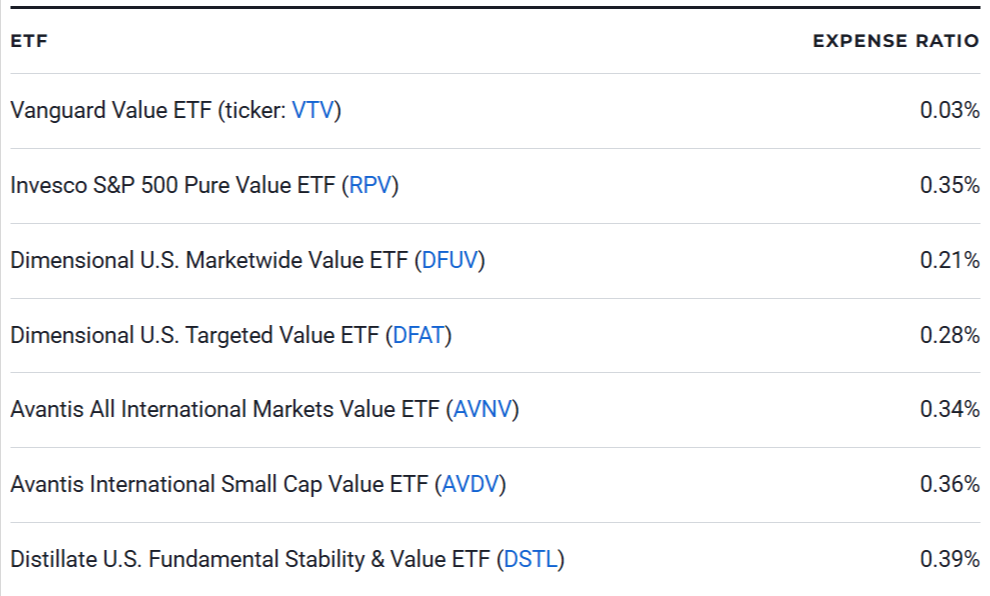
Here are seven of the best value ETFs to buy and hold in 2026:
ETF
Vanguard Value ETF (ticker: VTV)
Invesco S&P 500 Pure Value ETF (RPV)
Dimensional U.S. Marketwide Value ETF (DFUV)
Dimensional U.S. Targeted Value ETF (DFAT)
Avantis All International Markets Value ETF (AVNV)
Avantis International Small Cap Value ETF (AVDV)
Distillate U.S. Fundamental Stability & Value ETF (DSTL)
Vanguard Value ETF (VTV)
“If you are looking at a long-term, buy-and-hold retirement investment, consider a passive value ETF, ” Custovic says. “These will track an index and have lower fees than an actively managed ETF.” An inexpensive value ETF like VTV can do the heavy lifting. Like most Vanguard funds, VTV is very affordable, charging a 0.03% expense ratio. For a $10,000 investment, this works out to $3 in annual fee drag.
This ETF tracks a portfolio of 312 companies represented by the CRSP US Large Cap Value Index. VTV’s portfolio has a price-to-earnings (P/E) ratio of 21.2, but it still maintains good quality, with an average 16.2% return on equity. VTV’s value screens also pull double duty as a decent dividend strategy, with a 1.9% 30-day SEC yield paid on a quarterly basis.
Invesco S&P 500 Pure Value ETF (RPV)
“RPV is an enhancement to S&P’s style methodology aimed at providing more targeted exposure to value stocks in the S&P 500 index,” says Nick Kalivas, head of factor and core equity ETF product strategy at Invesco. “Stocks in the portfolio are weighted by their value score, not market cap, and there is no overlap with growth stocks like the first-generation S&P 500 style indices.”
Compared with broader value ETFs such as SPYV, RPV’s portfolio is far more concentrated, with just 124 holdings. On average, the portfolio trades at about 14.5 times earnings, though this comes with weaker profitability metrics, such as a 7.7% return on equity. Because the methodology is more complex than a traditional market-cap-weighted index, RPV also carries a higher 0.35% net expense ratio.
Dimensional U.S. Marketwide Value ETF (DFUV)
“The value premium is underpinned by straightforward logic: All else being equal, paying a lower price for a stock and its future cash flows can lead to higher expected returns,” says Marlena Lee, global head of investment solutions at Dimensional Fund Advisors. “ETF solutions designed around value can be a sensible way to orient portfolios to potentially outperform benchmarks.”
Dimensional has extensive experience implementing value strategies through its mutual funds, and over the past several years the firm has significantly expanded its lineup of factor-based ETFs. DFUV represents the firm’s broad U.S. value strategy within that newer ETF platform. Despite being actively managed, the ETF remains competitively priced relative to many peers, at a 0.21% expense ratio.
Dimensional U.S. Targeted Value ETF (DFAT)
“Dimensional’s value strategies use reliable information in prices to target higher expected returns within value stocks,” Lee explains. “A daily flexible process allows us to maintain consistent emphasis on higher-expected-return securities through time, while still being competitively priced within the lowest quartile of Morningstar category peers.” For more concentrated value exposure, consider DFAT.
Compared to DFUV, DFAT’s portfolio skews more toward smaller companies, but it remains diversified. “Dimensional has decades of experience helping investors with our rules-based approach, which incorporates profitability alongside size and value into security selection and uses daily implementation to maintain consistent focus on the asset class.” Lee explains. DFAT charges a 0.28% expense ratio.
Avantis All International Markets Value ETF (AVNV)
“Many confuse value as just being something that is low-priced, but a low price due to low profits or a weak balance sheet is not necessarily value – those are companies that have a low price because they deserve one and do not present an attractive investment opportunity,” says Eduardo Repetto, chief investment officer at Avantis Investors. These companies are often called “value traps.”
Investors looking to diversify country-specific risk may prefer an international value ETF like AVNV. The fund invests across both developed and emerging markets while incorporating profitability screens alongside traditional value measures. This combination seeks to identify companies that are not only attractively priced but also financially sound. AVNV charges a 0.34% expense ratio.
Avantis International Small Cap Value ETF (AVDV)
“Small-cap companies trading at attractive prices and with good profitability are trading at very appealing relative valuations looking back the last 20-plus years,” says Daniel Ong, senior portfolio manager at Avantis Investors. “These companies present a great opportunity versus other parts of the market that are trading at rich multiples.” These companies can be captured with small-cap value ETFs.
For international small-cap value exposure, AVDV has become one of the more popular ETFs in the category. The fund currently has about $17.3 billion in assets under management and has outperformed its benchmark, the MSCI World ex-U.S. Small Cap Index, over the trailing five-, three- and one-year periods. As of March 12, AVDV is up 7.3%. The ETF carries a 0.36% expense ratio.
Distillate U.S. Fundamental Stability & Value ETF (DSTL)
Some modern value investors disagree with how the factor has traditionally been measured, often discarding metrics such as P/E or price-to-book ratios. A good example is DSTL, an actively managed value ETF that instead focuses on companies with low debt levels and stable cash flow. The strategy begins with a universe of 500 large-cap, profitable U.S. companies, similar to the S&P 500 index.
From there, DSTL’s portfolio is narrowed to 100 companies based on debt levels and weighted based on free cash flow rather than market capitalization, rebalanced quarterly. “Utilizing free cash flow yield rather than earnings or book value allows you to avoid accounting issues, and once again accurately assess the relative opportunities in the market,” Cole explains. DSTL charges a 0.39% expense ratio.
