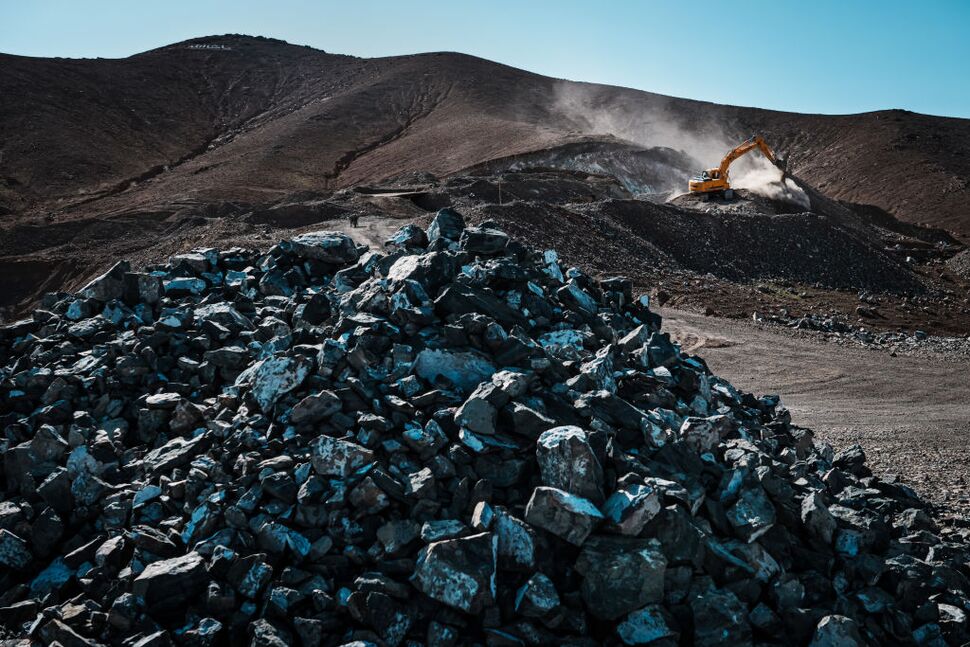
In late March, U.S. critical minerals company Glomar Minerals and Australian mining and processing company Cobalt Blue Holdings Ltd. (ticker: OTC: CBBHF) announced plans to build the world’s first commercial-scale facility for processing minerals found on the ocean floor.
Separately, last month the U.S. National Oceanic and Atmospheric Administration said one of its ships would begin mapping 8,000 square nautical miles of seabed under federal waters in the Pacific in April as part of the push for critical minerals including rare earth elements. Those particular minerals are found in nodules on the seabed. This is an example of the far-flung actions the U.S. is taking to attain rare earths outside of China.
What Are Rare Earth Minerals and Why Should You Invest?
Rare earth elements are crucial to smartphones, electric vehicles, renewable energy installations and military applications. It’s these elements and other critical minerals that are at the heart of the Trump administration’s interest in Greenland, Ukrainian mineral rights and plans for the $12 billion Project Vault critical and strategic mineral reserve.
The 17 rare earth elements aren’t really rare. They’re scattered throughout the earth’s crust. But deposits that are large and dense enough to mine economically are few and far between, and separating them from other elements can also be tricky.
Like with many commodities, China dominates the rare earth market, holding 90% of the globe’s processing capacity and making up 70% of mined production. One reason China is in that position: Mining and processing these elements can harm the environment, so countries like the U.S. ceded that market to the Asian nation because of its lower environmental standards. Cheaper labor is another reason, as are government subsidies and the location of reserves. Globalization formed the backdrop, allowing countries to outsource their rare earth needs.
Why Seek Alternatives to China’s Rare Earth Minerals?
Rare earths have become a hot topic in the commodities world amid trade tensions between the U.S. and China, an increasing interest in natural resource security after Russia’s invasion of Ukraine, and the push around the world to build more green energy systems to help reduce greenhouse gas emissions.
“China dominates the rare earth market and its supply chain,” says Esther Sholes, a senior macro analyst for futures funding platform Take Profit Trader. “This dominance allows China to use rare earths as a geopolitical tool, not just in trade disputes, but in response to broader strategic conflicts.”
She points to China’s move in January to restrict rare earth exports to Japan because of Japanese political statements about Taiwan and potential military involvement.
As the U.S. seeks an ex-China supply chain for rare earth elements, mining and processing ventures like the seabed nodule consortium are cropping up and providing investors opportunities but also risks.
“The more attractive opportunity is in the buildout of alternative supply chains outside China, as governments and companies are willing to subsidize and overpay for secure supply,” Sholes says. “The risk is that these projects are capital-intensive, take years to scale, and can be undermined if China responds by flooding the market and compressing margins. The investment case is therefore less about owning the commodity, and more about owning the right part of the new supply chain as it gets built.”
With that in mind, let’s explore some ways investors can get exposure to rare earth elements:
MP Materials Corp. (MP)
This U.S. mining company has deals with the U.S. Department of Defense and Apple Inc. (AAPL), giving it a certain amount of stability that smaller rare earth companies that aren’t yet in production don’t have.
MP is the only domestic company mining and processing rare earth elements. The company operates the Mountain Pass mine in California. From the 1960s until the mid-1980s, that mine made the U.S. the world’s biggest producer of rare earth elements.
The company has begun producing refined rare earth products at Mountain Pass, a step the company says is a milestone for “returning the full rare earth supply chain to the United States.”
Lynas Rare Earths Ltd. (OTC: LYSDY)
Another company outside of China that mines rare earths is Lynas Rare Earths, which extracts rare earth elements from its high-grade mine in Australia and processes rare earth minerals.
Like MP Materials, Lynas has backing from the U.S. Department of Defense, a sign of how eager Washington is to build up the supply of rare earths outside of China. The company’s U.S. subsidiary is working on facilities in Texas that will process both light and heavy rare earth elements – a designation based on where the elements fall on the periodic table.
American Resources Corp. (AREC)
Supplying rare earth elements doesn’t just mean digging them out of the ground. There are also companies that provide the elements through recycling.
This company isolates and purifies rare earth metals from end-of-life permanent magnets from wind turbines and electric vehicles. American Resources and Purdue University have been able to achieve a high purity of rare earth element neodymium through the recycling of waste magnets.
American Resources owns a minority position in rare earth refining company ReElement Technologies, which this month announced a collaboration with Mitsubishi Materials Corp. (OTC: MIMTF)。 In the U.S., the partnership will focus on feedstock sourcing, tolling and offtake opportunities for ReElement’s refining operations and, in Japan, will look at developing and commercializing rare earth and critical minerals recycling solutions.
ReElement also has U.S. government backing, with $1.4 billion in funding from the Defense Department to support the expansion of ReElement’s partnership with rare earth magnets startup Vulcan Elements on a vertically integrated, domestic rare earth magnet supply chain.
Rare Earth ETFs to Buy
Despite the opportunity that the above three companies offer, there are always risks involved with investing in any individual company. To help hedge those risks, investors can turn to the exchange-traded fund market. ETFs, as they are known, are investment vehicles that trade on an exchange under a ticker symbol just like a stock but contain holdings in many different companies.
These funds offer diversification that spreads out the company-specific risk. That diversification comes with a potential performance penalty. Because the funds have exposure to so many different companies, they’re unlikely to perform as well as a single company that experiences some kind of positive catalyst for its shares.
VanEck Rare Earth and Strategic Metals ETF (REMX)
For rare earths, investors can consider the VanEck Rare Earth and Strategic Metals ETF. The fund has $2.6 billion in assets under management and has been around since 2010. That longevity is saying something in the themed ETF world, where trendy or very specific funds often don’t make it. REMX has an expense ratio of 0.58%, or $58 per year for every $10,000 invested.
Its No. 4 holding is China Northern Rare Earth Group High-Tech Co. Ltd. (600111.SS)。 This company is the biggest rare earth mining company in the world, making it an important consideration for rare earth investors. The miner is listed on the Shanghai Stock Exchange, but there aren’t American depositary receipts for it, making REMX an easy option for U.S. investors to get exposure to this rare earths juggernaut.
Sprott Critical Materials ETF (SETM)
The Sprott Critical Materials ETF is another fund investors can consider for a one-stop shop of rare earth investments. With an inception date of 2023, the fund is newer than the VanEck offering. The fund has an expense ratio of 0.65%.
Both of these funds also contain companies that are primarily involved in producing other key commodities, such as lithium, that aren’t considered rare earth elements. So there are other market considerations investors should take note of.
For example, the fund’s portfolio has about 13% of its holdings in rare earth companies, while 26% are copper stocks and 25% are uranium equities.
