If you are new to bond investing, it helps to start with the concept of the risk-free rate. Practically speaking, this refers to the return investors can expect from lending short-term to the U.S. government.
A common proxy for the risk-free rate is the federal funds rate, set by the Federal Reserve as part of its dual mandate of maintaining maximum employment and stable inflation. As of the Federal Reserve’s March 2026 meeting, the rate sits in a target range of 3.5% to 3.75%.
This serves as a baseline for return expectations in the absence of risk. If you want to earn more than that, you need to take on additional risk. In bond investing, that typically manifests in two ways.
The first is credit risk. In general, lenders demand higher coupons to compensate for lending to borrowers with weaker financial health. Investment-grade bonds are rated BBB or higher, while bonds rated below that are considered high yield or “junk.” As you move down the credit spectrum, income potential increases, but so does the risk of default.
The second is maturity risk. All else being equal, longer-term bonds tend to offer higher yields because investors require compensation for locking up their money for a longer period. That said, this relationship can shift. During periods when the yield curve inverts, short-term bonds may temporarily offer higher yields than long-term bonds, though this tends to be the exception rather than the rule.
Accessing bonds through a mutual fund or an exchange-traded fund (ETF) can make these two risk factors easier to evaluate. Managers such as Fidelity Investments provide transparency into various bond fund portfolio characteristics.
These can include average credit quality, the breakdown between investment-grade and high-yield bonds, and maturity ranges. They also report duration, which measures how sensitive a bond fund’s portfolio is to changes in interest rates. Finally, bond funds typically distribute income monthly, unlike individual bonds, which usually pay interest on a semi-annual basis.
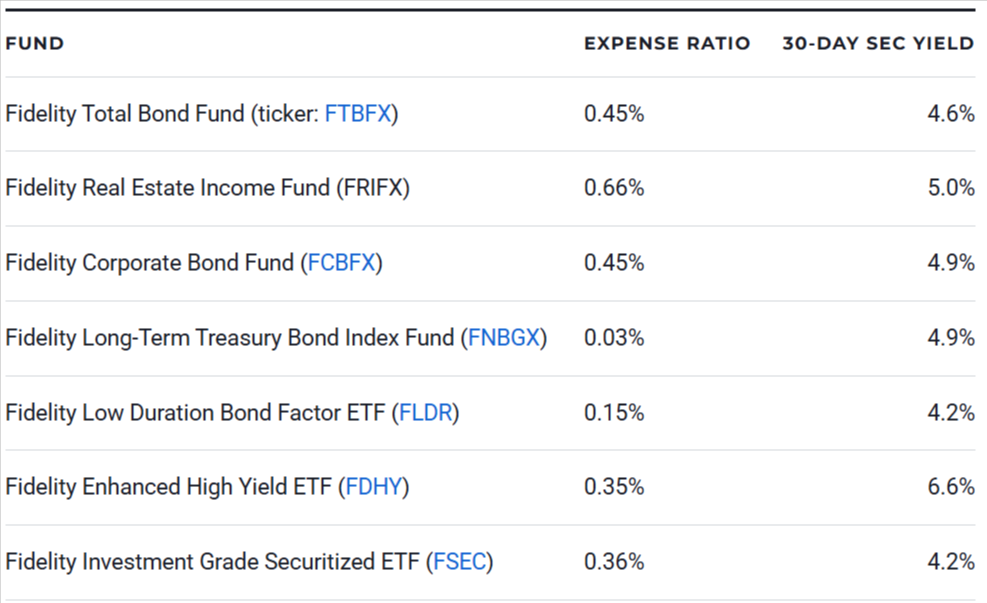
Here are seven of the best Fidelity bond funds to buy for steady income, all screened for a 30-day SEC yield of 4% or higher:
Fund
1.Fidelity Total Bond Fund (ticker: FTBFX)
2.Fidelity Real Estate Income Fund (FRIFX)
3.Fidelity Corporate Bond Fund (FCBFX)
4.Fidelity Long-Term Treasury Bond Index Fund (FNBGX)
5.Fidelity Low Duration Bond Factor ETF (FLDR)
6.Fidelity Enhanced High Yield ETF (FDHY)
7.Fidelity Investment Grade Securitized ETF (FSEC)
Fidelity Total Bond Fund (FTBFX)
“The fixed-income markets are one of the few markets that are non-exchange-traded, and thus having experience and relationships can create an advantage,” says Jeffrey Kalapos, chief investment officer at Coastal Bridge Advisors. “Understanding the management team’s investment philosophy, process and past experience is paramount.” Most Fidelity active bond funds will provide this information.
FTBFX is a good example. Fidelity discloses that the fund is managed by a team of nine co-managers, and the strategy targets 80% investment-grade bonds and up to 20% in non-investment-grade securities. Fidelity also provides manager commentary that highlights which bond selections contributed to or detracted from performance. FTBFX charges a 0.45% expense ratio, and pays a 4.6% 30-day SEC yield.
Fidelity Real Estate Income Fund (FRIFX)
“Understanding the fund’s true purpose and guideline constraints are often overlooked in the diligence process,” Kalapos says. “More strict guidelines can be both positive or negative, depending on the type of exposure you are trying to seek – one potential effect is that it may negatively limit the portfolio management’s investment options.” Investors can see this dynamic in play with FRIFX.
Unlike FTBFX, FRIFX operates under more defined constraints. The fund is required to invest at least 80% of its assets in securities tied to the real estate industry. This can include real estate investment trust debt, preferred and common stock, as well as commercial and agency mortgage-backed securities. FRIFX charges a 0.66% expense ratio and currently offers a 5% 30-day SEC yield.
Fidelity Corporate Bond Fund (FCBFX)
“Generally speaking, higher income comes at greater credit risk because investors need to be compensated for the additional credit-risk premium over comparable Treasury bonds, which are virtually risk-free in terms of default,” says Mark Andraos, partner and wealth advisor at Regency Wealth Management. Investors comfortable with this trade-off may find corporate bond funds appealing.
FCBFX focuses primarily on investment-grade corporate bonds, with about 57.5% of the portfolio rated BBB and 27.5% rated A. Roughly 80% of holdings are issued by U.S. companies, with additional exposure to developed markets such as Canada, the U.K., Ireland, Germany and France rounding out the fund. After accounting for a 0.45% expense ratio, FCBFX currently offers a 4.9% 30-day SEC yield.
Fidelity Long-Term Treasury Bond Index Fund (FNBGX)
Investors looking to increase yield without taking on significant credit risk may find FNBGX appealing. The fund tracks the Bloomberg U.S. Long Treasury Index, which holds Treasury securities with maturities of 10 years or more. As a result, the portfolio carries very high credit quality compared with corporate bond funds, though yields are typically lower than similarly dated corporate bonds.
Despite minimal credit risk, FNBGX still offers a 4.9% 30-day SEC yield by taking on greater interest rate risk. The fund has an average duration of 14.6 years, meaning a 1% rise in interest rates could lead to an approximate 14.6% decline in net asset value, while falling rates would have the opposite effect. As a passive index-tracking bond fund, FNBGX is also low-cost, with a 0.03% expense ratio.
Fidelity Low Duration Bond Factor ETF (FLDR)
Long-term bond funds such as FNBGX are generally better suited for investors with a higher risk tolerance and longer time horizon, as they can better withstand periods of rising interest rates. This occurred in years like 2022, when long duration detracted from performance. Investors with shorter time horizons or lower risk tolerance may prefer a short-duration bond fund like FLDR.
FLDR passively tracks the proprietary Fidelity Low Duration Investment Grade Factor Index. The portfolio is primarily composed of investment-grade floating-rate notes and Treasury securities. It maintains an average duration of under one year, which Fidelity classifies as an “ultra short” bond strategy. After a 0.15% expense ratio, the ETF currently offers a 4.2% 30-day SEC yield.
Fidelity Enhanced High Yield ETF (FDHY)
Investment-grade corporate bonds typically offer a yield premium over Treasurys of similar maturity, while high-yield bonds provide an additional yield pickup over investment-grade debt. Investors willing to take on that added credit risk can access the segment through FDHY, an actively managed ETF with a meaningful allocation to below-investment-grade bonds and a shorter-than-average maturity profile.
The fund currently pays a 6.6% 30-day SEC yield after deducting a 0.35% expense ratio. That higher income comes with higher default risk and greater sensitivity to economic downturns compared with investment-grade bond funds. However, in improving economic conditions, or when credit spreads tighten, FDHY may also benefit from capital appreciation in addition to income.
Fidelity Investment Grade Securitized ETF (FSEC)
In addition to government Treasurys and corporate bonds, the investment-grade universe also includes securitized debt. These are bonds backed by pools of assets such as mortgages and are often issued by entities chartered or sponsored by Congress. Investors looking to access this segment can consider FSEC, which charges a 0.36% expense ratio and currently offers a 4.2% 30-day SEC yield.
FSEC is actively managed and holds a large share of securities issued by agencies such as the Government National Mortgage Association, the Federal National Mortgage Association and the Federal Home Loan Mortgage Corp. One additional consideration is that the fund can employ modest leverage through derivatives such as swaps, options and futures.
