Cybersecurity stocks have been correcting along with others over the first quarter of 2026, including big industry names such as CrowdStrike Holdings Inc. (ticker: CRWD) and Palo Alto Networks Inc. (PANW)。 However, Wall Street continues to expect future profit growth as demand for their services remains high.
In fact, Wolfe Research upgraded CRWD stock to “outperform” with a $450 price target on March 30, sending shares up 5% in midday trading (CRWD closed at $369.58 on March 27)。 Meanwhile, PANW shares surged 7% after Palo Alto Networks CEO Nikesh Arora added $10 million in company stock to his sizable investment.
Other companies in the industry, such as Cloudflare Inc. (NET), enjoyed a strong 2025, with revenues soaring 29.8% and its stock surging more than 75% during that calendar year.
Cyber threats and data breaches aren’t going away anytime soon, and a recent uptick in cybersecurity fears in the wake of the U.S. conflict with Iran has caused Wall Street to become more bullish toward industry stocks as prospective threats are expected to grow.
For investors who want exposure to this industry but don’t want to pick individual stocks, cybersecurity exchange-traded funds, or ETFs, may be a sound choice.
“As businesses and nations scramble to secure their data, cybersecurity firms are raking in billions, making this a high-growth investment niche,” says Andrew Latham, a certified financial planner and content director at SuperMoney.
The escalating frequency and sophistication of online threats pose a significant risk for businesses across all sectors of the economy, says Arne Noack, regional investment head for Xtrackers, Americas at DWS Group in New York.
“This is further evidenced by the fact that the U.S. Department of Defense has identified cybersecurity as one of the 14 critical technologies for the United States’ national security, as cyberattacks increasingly target critical infrastructure and financial systems,” Noack adds.
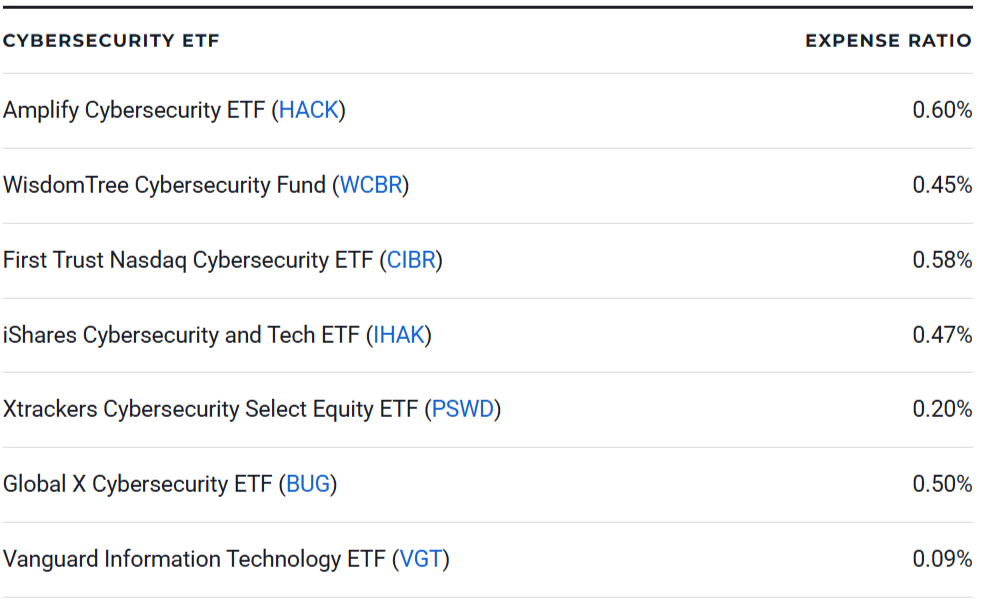
Here’s a look at seven cybersecurity ETFs to give investors access to this growing area of the market:
Cybersecurity ETF
Amplify Cybersecurity ETF (HACK)
WisdomTree Cybersecurity Fund (WCBR)
First Trust Nasdaq Cybersecurity ETF (CIBR)
iShares Cybersecurity and Tech ETF (IHAK)
Xtrackers Cybersecurity Select Equity ETF (PSWD)
Global X Cybersecurity ETF (BUG)
Vanguard Information Technology ETF (VGT)
Amplify Cybersecurity ETF (HACK)
The Amplify Cybersecurity ETF was launched in 2014, making it the first cybersecurity-themed ETF. It has $1.8 billion in assets under management, or AUM. Top holdings include Broadcom Inc. (AVGO), Cisco Systems Inc. (CSCO), Cloudflare, Fastly Inc. (FSLY) and Northrop Grumman Corp. (NOC)。 Its 25 equity holdings also include smaller, more specialized firms such as A10 Networks Inc. (ATEN)。
“It has an expense ratio of 0.6%, which is good but not great,” Latham says. However, it is considered relatively stable and growth-oriented and an excellent cybersecurity pure-play fund.
WisdomTree Cybersecurity Fund (WCBR)
This ETF tracks the WisdomTree Team8 Cybersecurity Index, which was established in October 2020. The ETF was launched soon after that, in January 2021. It currently has $71.1 million in assets under management, putting it in the ranks of smaller ETFs.
The vast majority of holdings are U.S.-based companies, with smaller weightings from Israel and Japan. It’s a fairly concentrated fund, with 24 holdings, and it has an expense ratio of 0.45%.
Because of WCBR’s preference for mid-cap and small-cap stocks, investors could see higher levels of price volatility with this ETF; with a beta of 0.99, the fund is currently closer to the market’s level of volatility, though that is historically atypical.
Although the fund has struggled to find momentum over the past two quarters, its high-tech holdings may be well positioned for growth should the industry focus on innovations as the prospect of new threats from the Middle East emerges.
First Trust Nasdaq Cybersecurity ETF (CIBR)
Another well-respected pure-play cybersecurity exchange-traded fund is the First Trust Nasdaq Cybersecurity ETF. With $9.5 billion in assets spanning 42 equities, CIBR is not the biggest ETF out there, but Morningstar says its cost advantage over its direct competitors keeps its strategy interesting to investors.
The fund’s top 10 holdings equate to around 61% of its total assets, and its largest investments include Cisco Systems, Infosys Ltd. (INFY) and Broadcom. It has a 30-day SEC yield over 0.8%.
Although CIBR is largely grounded in Wall Street cybersecurity stocks, the ETF also features a small collection of globally focused equities, including the Paris-listed Thales S.A. (HO.PA), which helps to introduce a level of geographical diversification.
iShares Cybersecurity and Tech ETF (IHAK)
Latham cites this ETF’s low expense ratio of 0.47% and its global exposure as key advantages. In addition to the U.S., holdings represent companies domiciled in Israel, Japan, Taiwan, Canada, Denmark, Germany and Malaysia. Its turnover is relatively low, making it a set-it-and-forget-it type of ETF, Latham says. Plus, this ETF has $700 million in assets; as it is part of the vast BlackRock ETF family, liquidity is unlikely to be an issue, Latham adds.
“If you want cybersecurity exposure without overpaying on fees, IHAK is a solid contender,” he says.
Xtrackers Cybersecurity Select Equity ETF (PSWD)
This is a relatively new ETF, having made its debut in July 2023. As you might expect from a young fund, it’s still on the very small side, with under $7 million in assets under management.
Its expense ratio is 0.2%, making it a cost-efficient option among U.S.-listed cybersecurity ETFs. Fund manager Xtrackers can keep costs low by simply tracking the Solactive Cyber Security ESG Index. “This index is a representation of securities that have business operations in the field of cybersecurity and that fulfill certain sustainability criteria,” says Noack, whose firm manages the fund. “Investors’ interest in cybersecurity companies remains strong, even in the recent market downturn,” he adds.
Among the largest holdings are Palo Alto Networks and Australia’s NextDC Ltd. (NXT.AX), as well as global stocks like Okta Inc. (OKTA), the Tokyo Stock Exchange-listed shares of Trend Micro Inc. (4704.T) and Check Point Software Technologies Ltd. (CHKP)。
Global X Cybersecurity ETF (BUG)
Latham calls this ETF the “high-risk, high-reward play.” It tracks the Indxx Cybersecurity Index, consisting of companies that generate at least 50% of their revenue from cybersecurity activities. “This means it’s concentrated in fast-growing, mid-cap firms rather than tech behemoths,” Latham says.
Top country representation includes the U.S., Israel, Japan and South Korea. This ETF’s fast growth and tilt toward mid-caps mean it could be more susceptible to volatility than the S&P 500, despite its five-month beta being relatively low at 1.01. Its expense ratio is a reasonable 0.5%.
“If you’re looking for an ETF with more upside potential and are cool with some turbulence, BUG could be your best bet,” Latham says.
Vanguard Information Technology ETF (VGT)
Although the globally renowned investment management firm Vanguard doesn’t have a pure-play cybersecurity ETF, its information technology-focused fund is an excellent choice for investors who would prefer to incorporate online security into a more diversified portfolio.
The Vanguard Information Technology ETF is a mammoth fund, with $126.5 billion in 323 holdings and an ultra-small expense ratio of 0.09%. This means that it can be a great low-cost choice if you’re looking to add cybersecurity stocks alongside other technology equities.
Having averaged 13.4% in annual returns since its launch in 2004, VGT is one of the most consistent performers on this list and is more resilient against sector volatility as a result.
