Activity in the initial public offering, or IPO, market can signal which industries are currently having a moment. Right now, nuclear energy is one of them.
On March 20, Rockville, Maryland-based X-energy filed paperwork with the Securities and Exchange Commission for a planned IPO on the Nasdaq. It’s the latest, and perhaps best-funded, small modular reactor company to enter the public markets. The company, backed by Amazon.com Inc. (ticker: AMZN), has raised $1.4 billion in venture funding.
J.P. Morgan and Morgan Stanley (MS) are leading the offering; involvement of major investment banks is a sign that Wall Street is optimistic about the company’s prospects.
Other recent activity in the nuclear energy IPO space includes:
Nano Nuclear Energy Inc. (NNE)。 The first portable nuclear microreactor company to list publicly in the U.S., Nano Nuclear went public in May 2024 at $4 per share. It’s currently trading at about $21, despite having no earnings yet.
One Nuclear Energy LLC. The company is advancing plans to go public through a special-purpose acquisition company merger (SPAC) with Hennessy Capital Investment Corp. The deal, valued at about $1.1 billion, is focused on small modular reactors. The acquisition is expected to close in the first half of this year.
General Fusion Inc. Another company pursuing a SPAC listing that’s expected to close in mid-2026. The merger with Spring Valley Acquisition Corp. would make General Fusion the first pure nuclear fusion company to trade publicly.
What’s Driving IPO Activity
AI data centers now consume enormous amounts of electricity, and the tech giants need more power around the clock. Microsoft Corp. (MSFT), Alphabet Inc. (GOOG, GOOGL) and Amazon have all signed nuclear power deals in the past two years.
But as with any red-hot industry, there are potential pitfalls.
“From an investment perspective, the sector has historically been challenging,” says Hayley Dickson, a certified financial planner and founder of Rippl Wealth Management & Insurance Solutions in Los Angeles.
Investable or Untouchable?
Nuclear energy may be a compelling story on paper, but returns only recently started to match the enthusiasm.
“Despite sound reasons to invest in nuclear over the last 15-plus years, real world progress in nuclear has failed to translate to outsized returns to investors until very recently, as in the last one to three years,” she says.
Dickson adds that she expects investor sentiment toward the nuclear industry to gyrate between “this theme is highly investable and this theme is untouchable, as it has in the past.”
With all that in mind, here are a handful of nuclear energy stocks and exchange-traded funds, or ETFs, to consider if you want exposure to the sector, along with any risks to understand before you buy:
Stock/ETF
Constellation Energy Corp. (CEG)
Cameco Corp. (CCJ)
GE Vernova Inc. (GEV)
Global X Uranium ETF (URA)
Sprott Uranium Miners ETF (URNM)
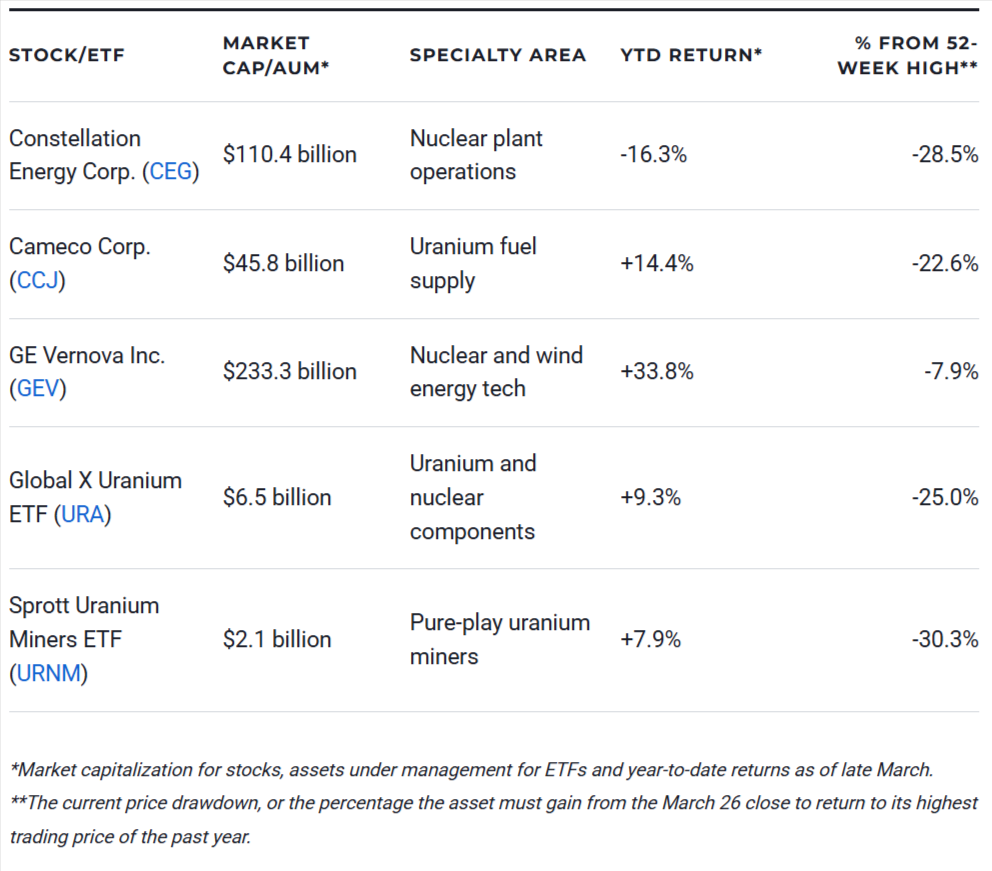
Constellation Energy Corp. (CEG)
If you want nuclear energy exposure through a company that’s generating power today, not ramping up for operations to begin in five years, Constellation offers direct access.
With a market capitalization of $110.4 billion, Constellation is among the largest nuclear power producers and operators in the U.S. It operates 55 gigawatts of capacity and supplies roughly 10% of the nation’s clean energy, serving about 2.5 million customer accounts.
A risk here is valuation: Constellation shares are currently correcting, but ran up 36.8% in the past year as of March 26. In addition, this can be a volatile stock, as illustrated by its beta of 1.16 (went to about 1.75 in late 2025)。
Cameco Corp. (CCJ)
This is another firm classified as a large-cap stock, although at $45.8 billion, its market capitalization is smaller than Constellation’s. Cameco is a popular component in energy ETFs.
“Its performance is closely linked to uranium price sentiment and the broader mining cycle, making it highly volatile,” says Andrew Izyumov, a chartered financial analyst who is CEO of 8Figures, an AI-driven investment platform based in Dover, Delaware.
Direct exposure to commodities and mining should be considered a high-volatility allocation, he adds. “Investors should be prepared for significant price fluctuations and ensure that such assets do not disrupt overall portfolio balance,” Izyumov says.
GE Vernova Inc. (GEV)
This stock was spun off from General Electric in March 2024. It’s in the power generation and electrification business, having a key role in nuclear energy. Its GE Hitachi Nuclear Energy unit designs and services reactors as utilities move to expand into other sources of reliable, readily available electricity that don’t produce carbon emissions.
Earnings growth has been strong and Wall Street is forecasting increases of 104% this year and 53% next year.
According to the company’s regulatory filings, the business depends on smooth operations, steady supply chains and favorable government policy. If the company’s execution stumbles or demand shifts, costs would likely rise and growth could quickly stall.
Global X Uranium ETF (URA)
This ETF invests mainly in global uranium mining companies based throughout the world, tracking an index of about 50 stocks. The largest countries represented are Canada, the U.S. and South Korea.
Stocks hail from the subindustries of mining, exploration and refining. The top weighted positions are Cameco, Nexgen Energy Ltd. (NXE) and Oklo Inc. (OKLO)。
Because it’s composed of volatile stocks, the ETF itself can show erratic returns from year to year. For example, it posted a small decline in 2024, finished 2025 with a gain of 67.3% and is up 9.3% year to date.
Here’s a rough breakdown of what it actually costs to own this fund over time: If you invested $10,000, you’d pay roughly $70 in the first year, $221 over three years, $384 over five years, and $859 over 10. That doesn’t include trading costs or taxes, which can gradually add to the total.
Sprott Uranium Miners ETF (URNM)
This 28-stock ETF is still relatively new, having launched in December 2019. It’s also on the smaller side, with just $2.1 billion in assets under management.
Like URA, it skidded in 2024 for a few reasons: Prices retreated after a surge, supply increased and demand fell. In addition, investors moved their money into other sectors, and because uranium stocks don’t trade as heavily as others, prices moved more sharply when they did.
Performance rebounded last year, with a gain of 40.6%.
In December 2025, this ETF’s underlying index was overhauled to kick out smaller, lightly traded uranium stocks and put more weight on bigger, more liquid companies. Holding larger, more actively traded stocks makes an ETF easier to trade and helps its price stay closer to what it actually owns.
