At any given time, the exchange-traded fund (ETF) industry is shaped by a mix of long-term structural trends and shorter-lived fads.
One of the most persistent has been fee compression, driven largely by intense competition among providers and led in part by firms like Vanguard, which has a cooperative ownership structure that allows it to aggressively lower costs for investors.
At the same time, another trend has emerged on the opposite end of the spectrum: a surge in ultra-high-yield ETFs offering double-digit distribution rates and more frequent payouts, often monthly instead of the traditional quarterly schedule.
Many of these high-yield strategies rely on derivatives and leverage to boost income, which can come at the expense of total return, especially after accounting for higher fees.
More recently, a niche subset of these products has taken things a step further by offering weekly distributions, targeting investors who prioritize steady cash flow.
“In our view, the weekly payout structure has durable applications to investment strategy,” explains Thomas DiFazio, ETF strategist at Roundhill Investments. “Weekly payers help investors manage their portfolios on a week-to-week basis, providing the flexibility to reinvest, time other investments or fund lifestyle expenses with each payout.”
However, this segment tends to include more complex strategies, often tied to single stocks or volatile indices, which can significantly increase concentration risk.
Another important consideration is how these distributions are taxed. A meaningful portion of payouts from these strategies may be classified as return of capital.
In a taxable account, return of capital is not immediately taxed but instead reduces your adjusted cost basis. Once that cost basis reaches zero, future distributions are taxed as capital gains, although the structure can allow investors to defer taxes in the meantime.
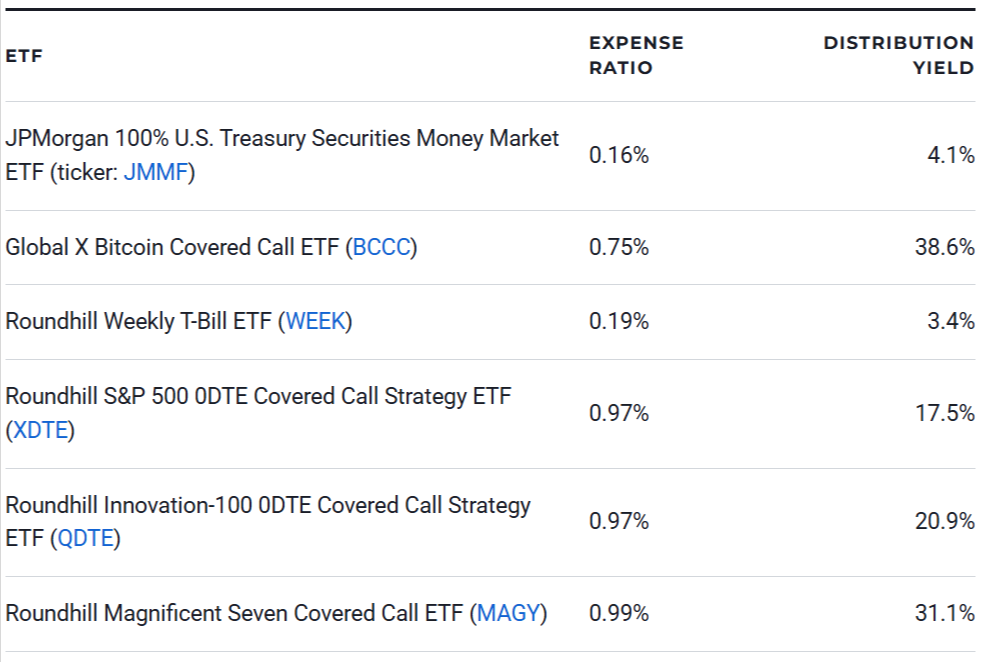
Here are six of the best ETFs to buy for weekly income in 2026:
ETF
1.JPMorgan 100% U.S. Treasury Securities Money Market ETF (ticker: JMMF)
2.Global X Bitcoin Covered Call ETF (BCCC)
3.Roundhill Weekly T-Bill ETF (WEEK)
4.Roundhill S&P 500 0DTE Covered Call Strategy ETF (XDTE)
5.Roundhill Innovation-100 0DTE Covered Call Strategy ETF (QDTE)
6.Roundhill Magnificent Seven Covered Call ETF (MAGY)
JPMorgan 100% U.S. Treasury Securities Money Market ETF (JMMF)
Money market funds are now available in ETF form, offering investors a familiar low-risk vehicle with added trading flexibility. While these ETFs do not maintain a fixed $1 per share net asset value (NAV), they remain low-risk. On a price chart, they often show a repeating weekly pattern where accrued interest gradually pushes the price higher before it drops on the ex-dividend date.
Notably, JMMF is one of the few money market ETFs that distributes income on a weekly basis. JMMF invests exclusively in U.S. Treasury bills, notes and bonds, making its distributions exempt from state income taxes. The ETF currently pays a 4.1% distribution yield and a 3.5% 30-day SEC yield, which tends to move in lockstep with the prevailing federal funds rate. JMMF charges a 0.16% expense ratio.
Global X Bitcoin Covered Call ETF (BCCC)
Bitcoin itself is not an income-generating asset, but investors can still access yield alongside some participation Bitcoin price exposure through a covered call ETF like BCCC, which charges a 0.75% expense ratio. This Bitcoin ETF is backed by cash collateral and an allocation to the VanEck Bitcoin ETF (HODL), alongside call and put options on the highly popular and liquid iShares Bitcoin ETF Trust (IBIT)。
Specifically, BCCC creates a synthetic long Bitcoin position by buying an IBIT call option and selling an IBIT put option with the same strike price and expiration. It then writes covered call options on IBIT, which caps upside price appreciation but generates income from option premiums. This structure can lead to elevated yields due to Bitcoin’s high volatility, with the ETF currently paying a 38.6% distribution yield.
Roundhill Weekly T-Bill ETF (WEEK)
“We view WEEK as an attractive defensive option, offering access to a safe-haven asset with the potential to generate income,” DiFazio says. Treasury bills are considered among the safest investments because they are backed by the full faith and credit of the U.S. government and carry minimal interest rate risk. While WEEK’s NAV is not fixed like a traditional money market fund, it tends to remain highly stable.
Owning Treasury bills directly requires reinvesting proceeds at maturity, since they are issued at a discount and do not make periodic interest payments, with returns realized when they mature at face value. In contrast, an ETF handles the constant turnover of Treasury bills and distributes income on a weekly basis, currently offering a 3.4% distribution yield after accounting for its 0.19% expense ratio.
Roundhill S&P 500 0DTE Covered Call Strategy ETF (XDTE)
“By tapping into structural mispricings in the zero-day-to-expiry (0DTE) market, XDTE can potentially dampen portfolio volatility while generating steady weekly income,” DiFazio says. XDTE captures returns from overnight price movements. During the trading day, the fund takes advantage of rapid time decay in 0DTE options to generate income more frequently than covered call ETFs that write options monthly.
The result is a higher distribution profile, currently 17.5% annualized based on the most recent weekly distribution and NAV. Despite the income focus, total returns have held up reasonably well. With distributions reinvested, XDTE returned 13% over the one-year period ending Dec. 31. Investors should note, however, that the strategy comes at a higher cost, with a 0.97% expense ratio.
Roundhill Innovation-100 0DTE Covered Call Strategy ETF (QDTE)
“Technology has borne the brunt of investor scrutiny due to the ongoing market rotation and rising geopolitical concerns following the onset of the Iran war,” DiFazio says. “In times of broader market stress, an income-first investment approach can help investors ground their portfolios and mitigate heightened market volatility.” One option is QDTE, which sells 0DTE Nasdaq-100 index options.
QDTE’s strategy is broadly similar to XDTE. The fund maintains overnight price exposure to its benchmark and then captures rapid time decay by selling 0DTE at the start of each trading day. Because the Nasdaq-100 is more volatile than the S&P 500 index, these options tend to generate higher premiums, which helps explain QDTE’s higher 20.9% distribution yield. The ETF also carries a 0.97% expense ratio.
Roundhill Magnificent Seven Covered Call ETF (MAGY)
Investors can obtain exposure to an equally-weighted portfolio of Amazon.com Inc. (AMZN), Apple Inc. (AAPL), Microsoft Corp. (MSFT), Alphabet Inc. (GOOG, GOOGL), Meta Platforms Inc. (META), Nvidia Corp. (NVDA) and Tesla Inc. (TSLA) via Roundhill’s Magnificent Seven ETF (MAGS)。 Those with around $5,850 in capital can also buy 100 shares of MAGS to sell covered calls, or they can outsource the work to MAGY at a 0.99% expense ratio
“For investors optimistic about the Magnificent Seven but who believe market volatility remains likely in the near term, MAGY has a thoughtful balance,” DiFazio says. “MAGY generates income through the sale of weekly covered calls while still offering capital appreciation potential.” MAGY’s 31.1% distribution yield surpasses even that of QDTE, although investors should remain aware of concentration risk.
