At the end of 2025, Warren Buffett stepped down as CEO of Berkshire Hathaway Inc. (ticker: BRK.A, BRK.B), telling the Wall Street Journal that he was “finally feeling his age.” Now 95, Buffett has transitioned into a secondary role as chairman, handing control over to successor Greg Abel, yet Buffett is still in the office five days a week and Abel speaks with him daily.
“Abel has been steeped in the Buffett philosophy, and has already stated unequivocally that he will firmly stick to the principles that made Berkshire successful,” says Adam Patti, CEO of VistaShares ETFs.
In his first annual letter, Abel reaffirmed Berkshire’s core principles, including disciplined capital allocation, a conservative approach to risk and a fortress balance sheet supported by substantial liquidity.
That liquidity remains significant, with Berkshire’s dry powder reaching $373 billion as of the most recent quarter, according to Yahoo Finance. “If Berkshire’s cash balance was a standalone public company, it would be around the 25th-largest publicly traded company,” says Patti.
Abel has also committed to maintaining several hallmarks of Berkshire’s approach under Buffett. The company does not plan to initiate a dividend, as management continues to believe retained earnings can generate greater long-term value; the equity portfolio will remain concentrated in a relatively small group of large-cap American companies; and Abel will take a more direct role in overseeing those investments.
In March, Abel also resumed stock buybacks for the first time in 22 months. Historically, Berkshire has repurchased shares when they trade below management’s estimate of intrinsic value. In Buffett’s words, this may reflect Abel’s willingness to buy “a wonderful company at a fair price.”
“Buybacks show confidence in the underlying portfolio and operations, but it also indicates that Berkshire is undervalued in Abel’s eyes as we move into a new market cycle,” Patti says. “Buffett put in place strict guidelines as to when buybacks will occur, and clearly valuation has met those parameters.”
Abel has also aligned his interests with shareholders by using his after-tax salary to purchase Berkshire class A shares, acquiring roughly $15.3 million worth. While modest relative to the company’s trillion-dollar market capitalization, it reinforces a culture of owner-operator alignment.
Even with Buffett no longer at Berkshire’s helm, his influence on investing remains firmly intact. Many exchange-traded fund (ETF) providers have launched strategies that either explicitly or indirectly reflect elements of his philosophy, from high-quality business selection to disciplined valuation.
“Overall, we believe the outlook for Berkshire over the coming years remains extremely bullish,” Patti says. “In fact, the CEO change itself may be viewed as a net positive over time given how well-respected Greg Abel is and how he has been trained by the best over the last 30-plus years.”
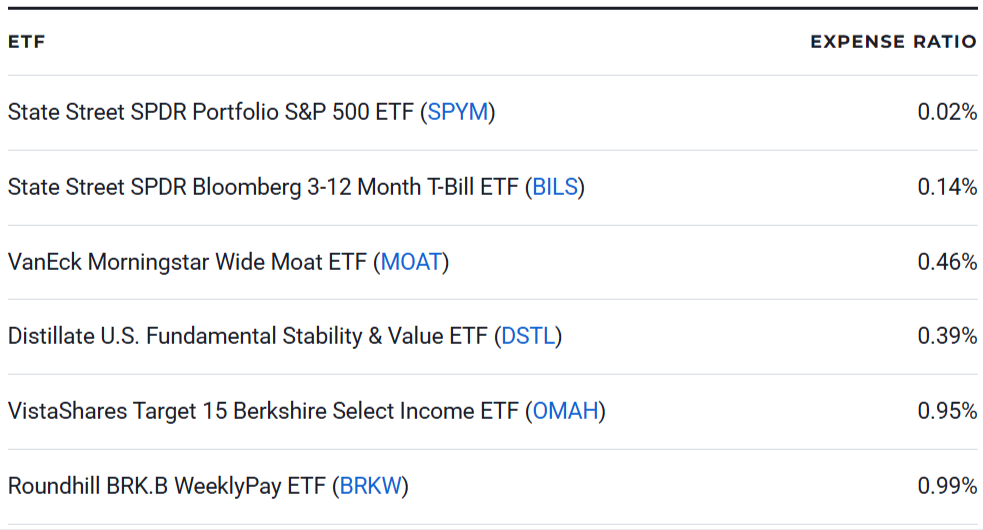
Here are six of the best ETFs to invest like Warren Buffett in 2026:
ETF
State Street SPDR Portfolio S&P 500 ETF (SPYM)
State Street SPDR Bloomberg 3-12 Month T-Bill ETF (BILS)
VanEck Morningstar Wide Moat ETF (MOAT)
Distillate U.S. Fundamental Stability & Value ETF (DSTL)
VistaShares Target 15 Berkshire Select Income ETF (OMAH)
Roundhill BRK.B WeeklyPay ETF (BRKW)
State Street SPDR Portfolio S&P 500 ETF (SPYM)
The Oracle of Omaha has long acknowledged his own mortality and has publicly outlined how he would like his estate to be invested. Buffett has stated that his posthumous allocation would consist of 90% in a low-cost S&P 500 index fund and 10% in short-term U.S. Treasury bonds. For investors looking to follow that guidance, SPYM offers a straightforward option with above-average tax efficiency.
While SPYM is neither the largest nor the oldest S&P 500 ETF, it features a rock-bottom expense ratio and strong liquidity thanks to a 0.01% 30-day median bid-ask spread. “Priced at just two basis points (0.02%), SPYM is the currently lowest-cost ETF tracking the S&P 500 index,” says Mark Alberici, senior managing director of State Street Global Advisors.
State Street SPDR Bloomberg 3-12 Month T-Bill ETF (BILS)
While some of Berkshire’s cash acts as a float for the insurance arm, Buffett has also used it opportunistically, acting as a lender and investor of last resort during periods of market stress such as in the aftermath of the 2008 financial crisis. Similarly, Buffett’s posthumous 90/10 allocation includes a portion in short-term Treasury bonds, emphasizing credit quality and liquidity over chasing higher yields.
Investors can access this exposure efficiently through an ETF like BILS, which tracks the Bloomberg 3-12 Month U.S. Treasury Bill Index. Holding short-term Treasurys in ETF form also avoids the need to use TreasuryDirect.gov and provides more convenient monthly income distributions. After deducting a 0.1354% expense ratio, BILS currently pays a 3.5% 30-day SEC yield that’s exempt from state taxes.
VanEck Morningstar Wide Moat ETF (MOAT)
“Warren Buffett may have passed the baton to Greg Abel, but the investment principles he refined over 60 years are bigger than any single CEO,” says Brandon Rakszawski, vice president and director of product management at VanEck. “MOAT was built on that same timeless foundation focused on companies with durable competitive advantages and attractive valuations.”
MOAT tracks the Morningstar Wide Moat Focus Index, which holds a concentrated portfolio of 55 companies. To be included, firms must demonstrate a competitive advantage expected to last more than 20 years, based on factors such as intangible assets, switching costs, network effects, cost advantages and efficient scale. In addition, holdings must trade below Morningstar’s estimate of fair value.
Distillate U.S. Fundamental Stability & Value ETF (DSTL)
Buffett’s investing philosophy has evolved over time. Early in his career as a student of Benjamin Graham, he focused on “cigar-butt” stocks – companies that were cheap enough to offer “one last puff” of value. After partnering with Charlie Munger, Buffett adopted a more balanced approach that emphasizes both quality and valuation. In ETF form, that strategy can be expressed via DSTL.
“Our process is really designed to systematically own a group of companies that mimic Buffett’s quality and value style with long-term returns as a priority,” explains Thomas Cole, co-founder at Distillate Capital Partners. “In that context, free cash flow is the ultimate measure of the performance of a business, and that is exactly what we assess when considering the prices stocks are trading for.”
VistaShares Target 15 Berkshire Select Income ETF (OMAH)
Investors who are more interested in Berkshire Hathaway’s public equity portfolio, rather than its wholly owned operating businesses like BNSF Railway, Geico and Duracell, can isolate that exposure through OMAH. This ETF holds Berkshire Hathaway class B shares alongside its 20 largest publicly disclosed equity positions, effectively packaging Buffett and Abel’s stock picks into a single ETF.
OMAH also incorporates a covered call strategy, which limits upside price appreciation but generates additional monthly income from option premiums. “We live in times with elevated volatility and geopolitical uncertainty, which is precisely when Berkshire tends to outperform,” Patti says. “We are excited about the prospects for OMAH, which offers the Berkshire portfolio but with a 15% annual yield.”
Roundhill BRK.B WeeklyPay ETF (BRKW)
OMAH has grown to $675 million in assets by targeting a niche of investors who appreciate Berkshire Hathaway’s equity portfolio but may be reluctant to invest directly due to its lack of dividends. Another way to address that gap is through BRKW. This single-stock ETF uses swaps in an attempt to deliver 1.2 times the weekly return of Berkshire Hathaway class B shares.
What makes BRKW unique is that a large portion of its return is expected to come from income distributions rather than pure price appreciation. The ETF currently offers a 17% distribution yield with weekly payouts, although that figure can fluctuate depending on market conditions. Investors should also account for the ETF’s higher cost, as BRKW carries a pricey 0.99% expense ratio.
