China is the world’s second-largest economy and is the largest emerging market. Emerging-market economies are experiencing rapid industrialization and may have higher growth potential than developed markets like the U.S. Other examples of emerging-market economies include Brazil, India and Russia.
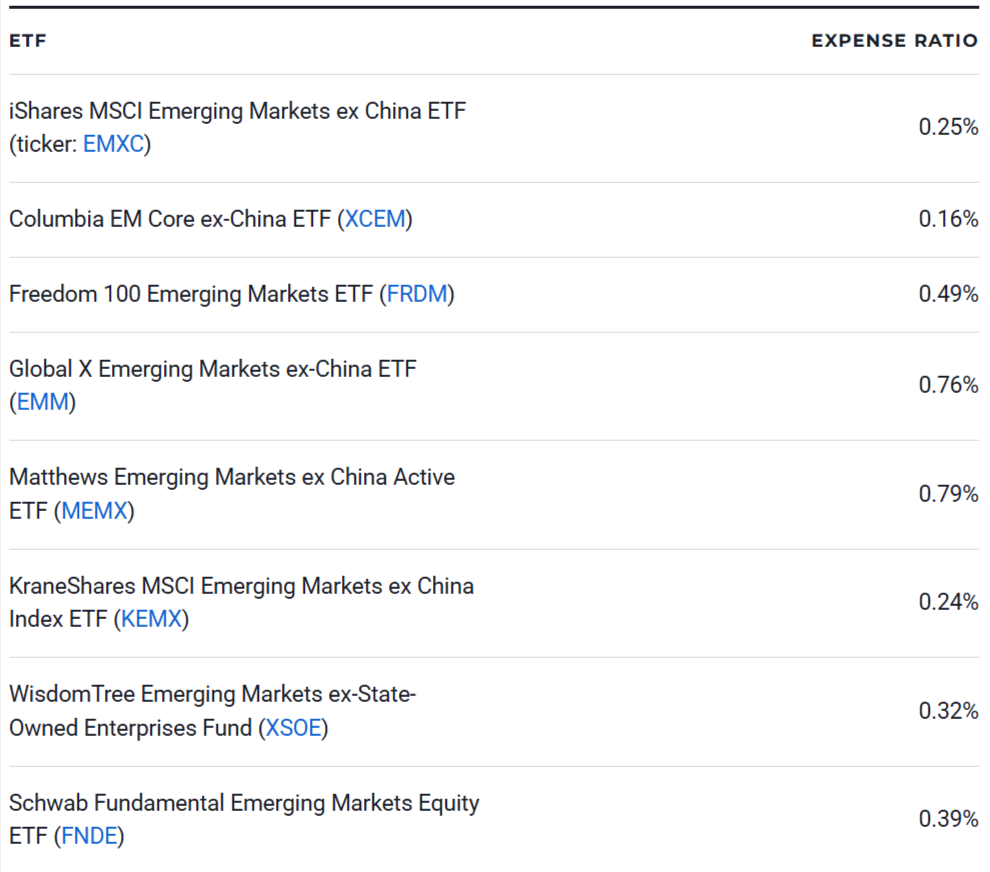
U.S. investors are growing increasingly concerned that geopolitical tensions between the U.S. and China – coupled with the Chinese Communist Party’s extensive influence over domestic public companies – make Chinese stocks too risky to rely on. Fortunately, these eight exchange-traded funds provide diversified exposure to emerging markets and have limited or no Chinese equity holdings:
ETF
iShares MSCI Emerging Markets ex China ETF (ticker: EMXC)
Columbia EM Core ex-China ETF (XCEM)
Freedom 100 Emerging Markets ETF (FRDM)
Global X Emerging Markets ex-China ETF (EMM)
Matthews Emerging Markets ex China Active ETF (MEMX)
KraneShares MSCI Emerging Markets ex China Index ETF (KEMX)
WisdomTree Emerging Markets ex-State-Owned Enterprises Fund (XSOE)
Schwab Fundamental Emerging Markets Equity ETF (FNDE)
iShares MSCI Emerging Markets ex China ETF (EMXC)
The iShares MSCI Emerging Markets ex China ETF tracks the MSCI Emerging Markets ex China index. The fund excludes small-cap equities and covers about 85% of the market cap of 25 emerging-market countries outside of China. Nearly 30% of its holdings are from Taiwan, followed by South Korea at 23% and India at 17%. The fund has 627 total holdings, and its top individual stock holdings include Taiwan Semiconductor Manufacturing Co. Ltd. (TSM), Samsung Electronics Co. Ltd. (005930.KS) and SK hynix Inc. (000660.KS)。 The EXMC fund has a 1.4% 30-day SEC yield, a 0.25% expense ratio and a four-star rating from Morningstar.
Columbia EM Core ex-China ETF (XCEM)
The Columbia EM Core ex-China ETF tracks an index of emerging-market companies outside of China and Hong Kong. The index includes the largest 700 emerging-market companies by market cap and is weighted by market capitalization as well. Geographically, the XCEM fund’s highest exposure is Taiwan (29%) followed by South Korea (20%) and India (18%)。 Its top stock holdings are also Taiwan Semiconductor Manufacturing, Samsung Electronics and SK hynix, which make up a combined 29% or so of the fund’s assets. The XCEM fund has a 1.7% 30-day SEC yield, an attractive 0.16% expense ratio and a five-star rating from Morningstar.
Freedom 100 Emerging Markets ETF (FRDM)
The Freedom 100 Emerging Markets ETF is another emerging-markets fund that has zero exposure to China, but it has a unique stock selection process. Countries are evaluated based on 76 variables that judge personal and economic freedom, and companies with 20% or more state ownership are excluded. The 10 largest, most liquid stocks from each qualifying country are included and are market cap-weighted within their countries’ respective weights. As a result, the FRDM fund has only 129 holdings. It has 22% exposure to Taiwan, 19% exposure to South Korea, 17% exposure to Chile and a five-star Morningstar rating.
Global X Emerging Markets ex-China ETF (EMM)
The Global X Emerging Markets ex-China ETF is focused on high growth potential outside of China, and its strategy provides investors access to smaller, sometimes overlooked markets. With only 39 stock holdings, EMM’s portfolio may seem more concentrated and less diversified than many other emerging-market ETFs. However, the EMM ETF invests in other ETFs in addition to stocks. In fact, its top holding is the Global X India Active ETF (NDIA) followed by Taiwan Semiconductor Manufacturing and Samsung Electronics. The EMM fund has a 0.9% 30-day SEC yield, a 0.76% expense ratio and a three-star Morningstar rating.
Matthews Emerging Markets ex China Active ETF (MEMX)
The Matthews Emerging Markets ex China Active ETF is structured to provide exposure to companies from emerging markets outside of China that have sustainable growth potential. Unlike passively managed ex-China emerging-market ETFs, the MEMX fund is actively managed. Stocks are selected based on a company-first investment strategy that emphasizes fundamental analysis rather than utilizing a top-down country- or sector-based allocation. The fund has 88 total holdings, and its top individual stock holdings are Samsung Electronics, Taiwan Semiconductor and SK hynix. The MEMX fund has a 0.79% expense ratio and a four-star rating from Morningstar.
KraneShares MSCI Emerging Markets ex China Index ETF (KEMX)
The KraneShares MSCI Emerging Markets ex China Index ETF tracks an index of large-cap and mid-cap emerging-market stocks outside of China. The KEMX fund is designed to be paired with KraneShares China-focused ETFs such as the KraneShares CSI China Internet ETF (KWEB) to allow investors to customize their exposure to China and find the right balance they can be comfortable with. The KEMX fund has 272 holdings and has 27% exposure to Taiwan, 25% exposure to South Korea and 17% exposure to India. It also has a 0.24% expense ratio and a five-star Morningstar rating.
WisdomTree Emerging Markets ex-State-Owned Enterprises Fund (XSOE)
The WisdomTree Emerging Markets ex-State-Owned Enterprises Fund offers investors another unique way to limit potential problem investments in China rather than exclude all Chinese stocks entirely. The fund includes equities of companies from all emerging markets, including China, but it excludes any companies that have more than 20% government ownership. As a result, the portfolio’s highest allocation is to Taiwan at 22% followed by China at 21% and South Korea at 18%. Top stock holdings include Taiwan Semiconductor Manufacturing, Samsung Electronics and Tencent. The XSOE fund has a 0.32% expense ratio and a three-star Morningstar rating.
Schwab Fundamental Emerging Markets Equity ETF (FNDE)
The Schwab Fundamental Emerging Markets Equity ETF tracks an index of emerging-market stocks. The FNDE does have some exposure to Chinese stocks. However, because its selection process is focused on fundamental factors such as sales, cash flow and dividends rather than market capitalization, it has significantly less exposure to Chinese mega-cap stocks than other emerging-market ETFs. The FNDE fund is only 30% invested in China, 20% in Taiwan and 13% in Brazil. Top holdings include Taiwan Semiconductor, Alibaba Group Holding Ltd. (BABA) and Vale S.A. (VALE)。 The fund has a 0.39% expense ratio and a five-star rating from Morningstar.
