When times get tough on Wall Street, many investors turn to high-yield dividend ETFs.
Exchange-traded funds provide a steady stream of income that isn’t dependent on buying low and selling high, and they can be particularly appealing to those at or near retirement who don’t want to be forced to liquidate positions during a downturn.
High-dividend-paying ETFs can come with drawbacks, however. Distributions are typically paid out regularly regardless of short-term market fluctuations, but those ups and downs can still be severe. These ETFs also tend to be more narrowly focused in strategy, reducing diversification in exchange for an emphasis on income potential.
Like any investment vehicle, these ETFs come with risk. But all are well established, with $200 million or more in assets and, most importantly, they all yield 7% or more.
ETF
VanEck Mortgage REIT Income ETF (ticker: MORT)
JPMorgan Nasdaq Equity Premium Income ETF (JEPQ)
JPMorgan Equity Premium Income ETF (JEPI)
Invesco S&P 500 Equal Weight Income Advantage ETF (RSPA)
Invesco MSCI EAFE Income Advantage ETF (EFAA)
Global X MLP ETF (MLPA)
/Global X SuperDividend ETF (SDIV)
Global X Variable Rate Preferred ETF (PFFV)
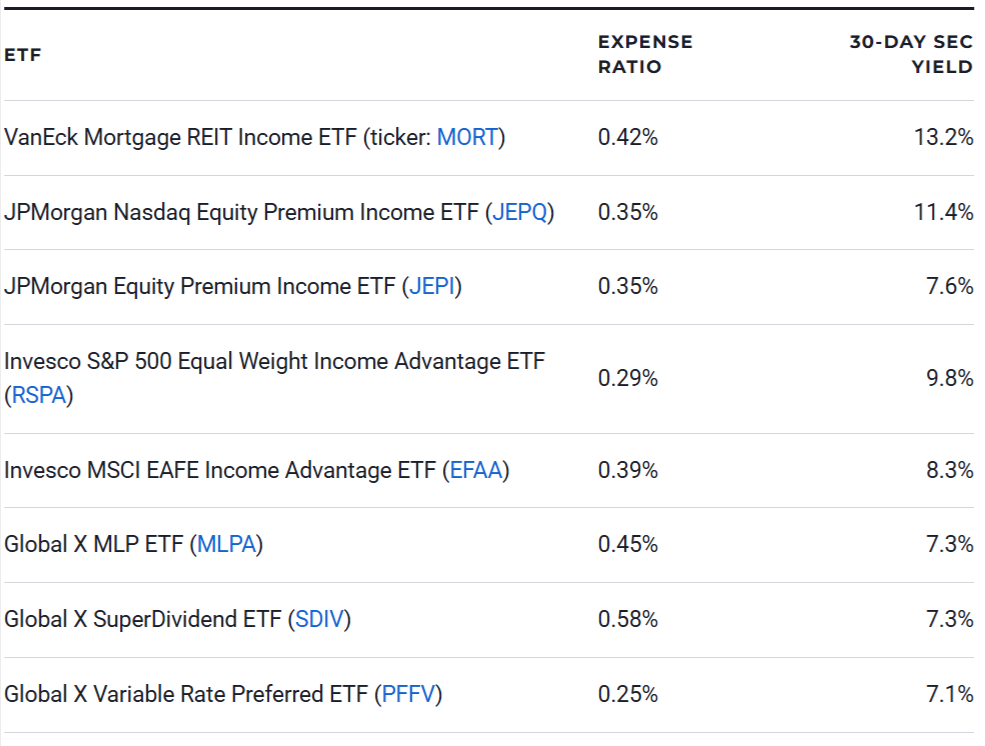
VanEck Mortgage REIT Income ETF (MORT)
A passive dividend ETF, this VanEck fund holds about 30 mortgage-related real estate investment trusts (REITs)。 REITs are a special class of company required to deliver 90% of taxable income back to shareholders, creating a mandate for large dividends. Not all of these companies own physical properties, however. Mortgage-related REITs hold real estate loans and generate income from the payments they receive. While sensitive to interest rates and risky due to the highly leveraged nature of these firms, leading names like Annaly Capital Management Inc. (NLY) and AGNC Investment Corp. (AGNC) offer stellar yields that make this income ETF noteworthy.
JPMorgan Nasdaq Equity Premium Income ETF (JEPQ)
JEPQ is an actively managed ETF that invests primarily in large-cap companies from the Nasdaq-100, giving it a tech-heavy tilt via top holdings like Nvidia Corp. (NVDA) and Apple Inc. (AAPL)。 There typically isn’t much yield in this corner of Wall Street, as Silicon Valley leaders tend to reinvest cash into growth rather than return it to shareholders. However, the fund generates additional income by selling covered-call options, allowing it to significantly boost payouts. This strategy may limit upside during strong market rallies, but for investors focused on income, this unique fund stands out among dividend ETFs.
JPMorgan Equity Premium Income ETF (JEPI)
Similar to the prior fund, JEPI is actively managed and also uses a covered-call strategy on large-cap U.S. stocks selected for quality and relatively low volatility. Its portfolio of roughly 100 holdings includes blue-chip names like Johnson & Johnson (JNJ), along with less-obvious picks like Ross Stores Inc. (ROST)。 Option premiums, combined with dividends from common shares, drive the fund’s yield, with an emphasis on stability and consistent income over time.
Invesco S&P 500 Equal Weight Income Advantage ETF (RSPA)
Continuing the theme, this Invesco fund also employs a covered-call strategy to generate income. It tracks an equal-weight version of the S&P 500, assigning roughly 0.2% to each company and regularly rebalancing to maintain that structure. This creates some unique sector exposures – for example, industrials and financials are the largest sectors, at about 17% and 14% each. Income is derived from both stock dividends and call option premiums.
Invesco MSCI EAFE Income Advantage ETF (EFAA)
Another options-focused strategy, this ETF tracks an index of international stocks across Europe, Australasia and the Far East. It offers exposure to global leaders like AstraZeneca PLC (AZN) and ASML Holding N.V. (ASML)。 Many of these companies tend to be more generous with dividends than their U.S. counterparts, and the added options overlay enhances income generation, making this fund a compelling choice for yield-seeking investors.
Global X MLP ETF (MLPA)
This Global X ETF provides targeted exposure to master limited partnerships, which benefit from special tax treatment due to their capital-intensive infrastructure operations. In return, they distribute a large share of profits to investors. Holdings like Energy Transfer LP (ET) and Enterprise Products Partners LP (EPD) drive the fund’s strong yield. While the portfolio is concentrated in 20 similar energy infrastructure companies, the income potential remains hard to ignore.
Global X SuperDividend ETF (SDIV)
This “super dividend” fund casts a wide net, seeking the highest yields across sectors and regions, with about 106 holdings. That approach comes with added risk. The portfolio is heavily weighted toward financials (32%) and real estate (20%), and it leans toward smaller companies, with an average market cap of about $4.1 billion. While the strategy delivers above-average yield, it differs significantly from more traditional dividend ETFs.
Global X Variable Rate Preferred ETF (PFFV)
This ETF invests in variable-rate preferred stocks, a hybrid between common equities and corporate bonds that already offer relatively high yields. The variable-rate structure allows payouts to increase when interest rates rise. Holdings include firms like Morgan Stanley (MS) and Allstate Corp. (ALL), though utilities make up about half the portfolio. With lower volatility than common stocks, PFFV offers a more stable way to capture elevated dividend income.
