With the first quarter of 2026 nearly over, equity markets have already delivered a heavy dose of volatility and uncertainty for investors.
As of March 13, the Chicago Board Options Exchange Volatility Index (VIX) had surged 87.39%. The VIX measures expected volatility in the S&P 500 over the next 30 days based on the prices of call and put options. In practice, a rising VIX often reflects elevated fear and defensive positioning across markets.
Geopolitical tensions remain elevated following the U.S-Israel war against Iran, which began Feb. 28. The conflict has raised concerns about energy markets, particularly as shipping traffic through the Strait of Hormuz has been effectively disrupted.
Despite the conflict, the S&P 500 index has only declined about 2.1% year to date and still sits near recent all-time highs. That combination of elevated valuations and rising uncertainty has led some active investors to reconsider their portfolio positioning.
In this environment, bond exchange-traded funds may provide safety. In particular, bond ETFs with shorter maturities and higher credit quality can dampen volatility while generating income.
“With yields still elevated, volatility lingering and central banks exercising caution, we believe bonds will continue to drive portfolio returns,” says JoAnne Bianco, partner and senior investment strategist at BondBloxx, an asset manager specializing in fixed-income ETFs.
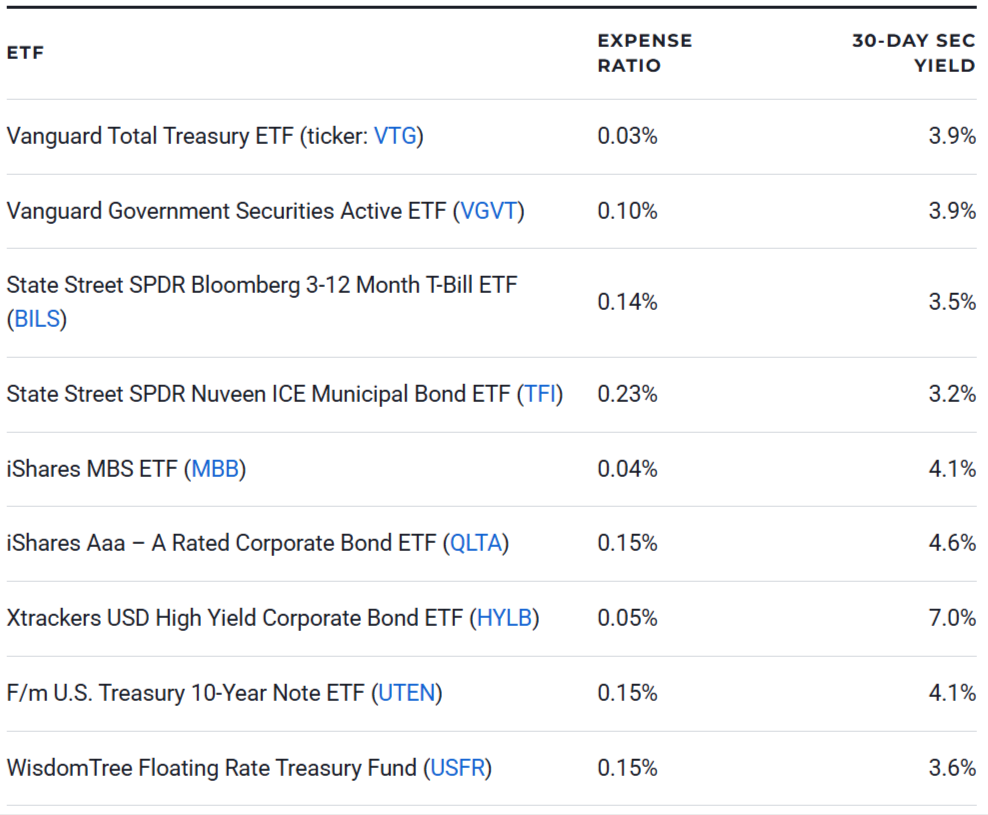
Here are nine of the best bond ETFs to buy in 2026:
ETF
Vanguard Total Treasury ETF (ticker: VTG)
Vanguard Government Securities Active ETF (VGVT)
State Street SPDR Bloomberg 3-12 Month T-Bill ETF (BILS)
State Street SPDR Nuveen ICE Municipal Bond ETF (TFI)
iShares MBS ETF (MBB)
iShares Aaa – A Rated Corporate Bond ETF (QLTA)
Xtrackers USD High Yield Corporate Bond ETF (HYLB)
F/m U.S. Treasury 10-Year Note ETF (UTEN)
WisdomTree Floating Rate Treasury Fund (USFR)
Vanguard Total Treasury ETF (VTG)
“Investors have seen bond ETFs successfully weather multiple storms in the markets, including the pandemic sell-off in March 2020,” says John Croke, head of investor choice business activation at Vanguard. “Time and again, bond ETFs have demonstrated their resilience and liquidity for investors.”
Unlike aggregate bond ETFs, VTG excludes corporate bonds and agency securities. Instead, VTG only holds Treasury bonds, balanced between short-, intermediate- and long-term. On average, VTG’s portfolio has a 5.8-year duration. The ETF charges a 0.03% expense ratio and pays a 3.9% 30-day SEC yield.
Vanguard Government Securities Active ETF (VGVT)
“Rich stock prices and attractive current yields are creating demand for bond ETFs – particularly actively managed ETFs – which helps investors who are seeking portfolio diversification with the additional profit potential that comes from active tilts,” says Stephen McFee, senior portfolio manager at Vanguard.
Vanguard’s active ETFs remain highly affordable. For instance, VGVT charges a 0.1% expense ratio. This ETF actively picks a portfolio of Treasury bonds and agency securities in an attempt to outperform the Bloomberg U.S. Government Total Return Index. VGVT currently pays a 3.9% 30-day SEC yield.
State Street SPDR Bloomberg 3-12 Month T-Bill ETF (BILS)
“Often overlooked in bond ETFs is liquidity – the ability to buy or sell the security quickly, easily and without a large spread,” says Daniel Dusina, chief investment officer at Blue Chip Partners. “A bond ETF’s liquidity, for the most part, is driven by the liquidity of its underlying securities.”
The most liquid bonds are Treasury bills with less than 12 months remaining until maturity. Investors can target this segment via BILS. This ETF has a less volatile share price and pays a 3.5% 30-day SEC yield, which fluctuates roughly in line with the prevailing federal funds rate. BILS charges a 0.14% expense ratio.
State Street SPDR Nuveen ICE Municipal Bond ETF (TFI)
Tax treatment can vary significantly across different types of bonds. For example, interest from U.S. Treasury bonds is generally exempt from state and local taxes but still subject to federal income tax. Corporate bond interest, by contrast, is typically taxed at both the federal and state levels.
For investors prioritizing tax efficiency, municipal bond ETFs like TFI can offer a potential solution. Because interest from municipal bonds is exempt from federal income tax, TFI’s current 3.2% 30-day SEC yield can be competitive for investors in higher income brackets. TFI charges a 0.23% expense ratio.
iShares MBS ETF (MBB)
“Mortgage-backed securities (MBS) ETFs offer yields that are comparable to investment-grade corporate bonds, accompanied with high credit quality and monthly cash flows,” says Dave P. Francis, investment advisor and principal at Bartlett Wealth Management. A popular option is MBB from iShares.
IBB passively tracks over 11,000 MBS represented by the Bloomberg U.S. MBS Index. Holdings include MBS issued by government-sponsored enterprises such as Ginnie Mae, Fannie Mae and Freddie Mac, which are rated AA. The ETF currently pays a 4.1% 30-day SEC yield and charges a 0.04% expense ratio.
iShares Aaa – A Rated Corporate Bond ETF (QLTA)
Bond investors looking for a yield pick-up without compromising too much on credit quality may find investment-grade corporate bonds attractive. The minimum rating for these bonds is BBB, but investors can also selectively target higher-rated segments using a more specialized bond ETF like QLTA.
This ETF tracks the Bloomberg U.S. Corporate Aaa – A Capped Index. In practice, 82% of QLTA is held in A-rated bonds, with no BBB exposure. Compared to Treasury-bond-only ETFs like VTG, QLTA pays a higher 4.6% 30-day SEC yield, but with poorer tax efficiency. The ETF charges a 0.15% expense ratio.
Xtrackers USD High Yield Corporate Bond ETF (HYLB)
Investors can potentially earn equity-like returns if they opt for a high-yield bond ETF. These ETFs own bonds rated below BBB, which are at greater risk of default. Investors get compensated with a higher yield, but tax efficiency remains poor. A good example is HYLB, which pays a 7% 30-day SEC yield.
“HYLB also has a shorter duration than most peers and offers superior liquidity, as bonds in the portfolio must have a minimum $400 million float,” says Ben Spalding, head of fixed-income portfolio management for Xtrackers Americas at DWS Group. HYLB charges a 0.05% expense ratio.
F/m U.S. Treasury 10-Year Note ETF (UTEN)
Among bond market benchmarks, one of the most closely watched is the 10-year Treasury yield. It serves as a key reference rate for financial markets, influencing everything from mortgage rates to corporate borrowing costs and equity valuations. Investors can track the 10-year yield via UTEN.
Unlike most bond ETFs that hold diversified portfolios, UTEN owns just one security: the latest issued, or “on-the-run,” 10-year Treasury note. This structure allows the ETF’s price to closely follow movements in the 10-year Treasury market. After its 0.15% expense ratio, UTEN pays a 4.1% 30-day SEC yield.
WisdomTree Floating Rate Treasury Fund (USFR)
Most bond ETFs tend to struggle when interest rates rise. All else being equal, newly issued bonds must offer higher yields to attract investors, which means existing bonds with lower yields must fall in price. This inverse relationship can lead to meaningful losses for bond ETFs when rates rise rapidly.
USFR, however, tends to perform differently in rising-rate environments. This lower-risk bond ETF holds floating-rate Treasury notes, paying coupons priced at a spread above three-month Treasury bills. USFR currently pays a 3.6% 30-day SEC yield after accounting for a 0.15% expense ratio.
