Quantum computing stocks are slower to heat up in 2026, with the benchmark S&P Kensho Global Quantum Computing Technologies Index up 12.4% year to date and up 81.3% over the past 12 months as of March 16. However, that’s a solid figure for quantum computing investors and for C-suite leadership, who are finally seeing sustainable industry growth after a decade of plodding market performance.
Even so, quantum computing stocks aren’t entirely out of the woods yet, market experts say. “Quantum computing is real, but it’s very early,” says Shay Boloor, chief market strategist at technology sector research firm Futurum. “The biggest misconception is that quantum computers will replace GPUs or make today’s AI data centers useless, but that couldn’t be more off.”
For now, GPUs, or graphics processing units, will continue to handle model training, inference and general-purpose artificial intelligence workloads, while quantum processors solve narrow, specialized problems that classical systems fundamentally struggle with, such as massive optimization, cryptography, simulation, navigation and timing.
“Increasingly, you’ll see hybrid architectures where CPUs orchestrate, GPUs do the heavy lifting, and QPUs act as accelerators for edge-case workloads,” Boloor says.
That process has already started, as Microsoft Corp. (ticker: MSFT) allows customers to use IonQ Inc. (IONQ) tech through Azure, Amazon.com Inc. (AMZN) offers quantum computing access through AWS, and Google is building quantum directly into its own data centers. “I don’t think companies will buy quantum computers, but they’ll rent quantum computing time through the cloud, just like they rent GPUs today,” Boloor says.
In the long term, quantum computing will likely emerge as a breakthrough technology that could complement AI’s progress. “The technology will play a pivotal role in solving some of society’s most complex challenges, from advanced data simulations and drug discovery to national security and supply chain optimization,” says Ido Caspi, research analyst at Global X ETFs. “At full scale, quantum computing can create over $450 billion of economic value by 2040, according to Boston Consulting Group.”
Quantum computing is expected to scale to $10 billion in revenues by 2030, supported by the industry’s shift in focus from simply increasing qubit counts to improving qubit stability. “That’s a critical step toward commercialization,” Caspi says. “Meanwhile, big tech giants and startups alike are racing to achieve quantum advantage while governments are investing billions in national quantum initiatives.”
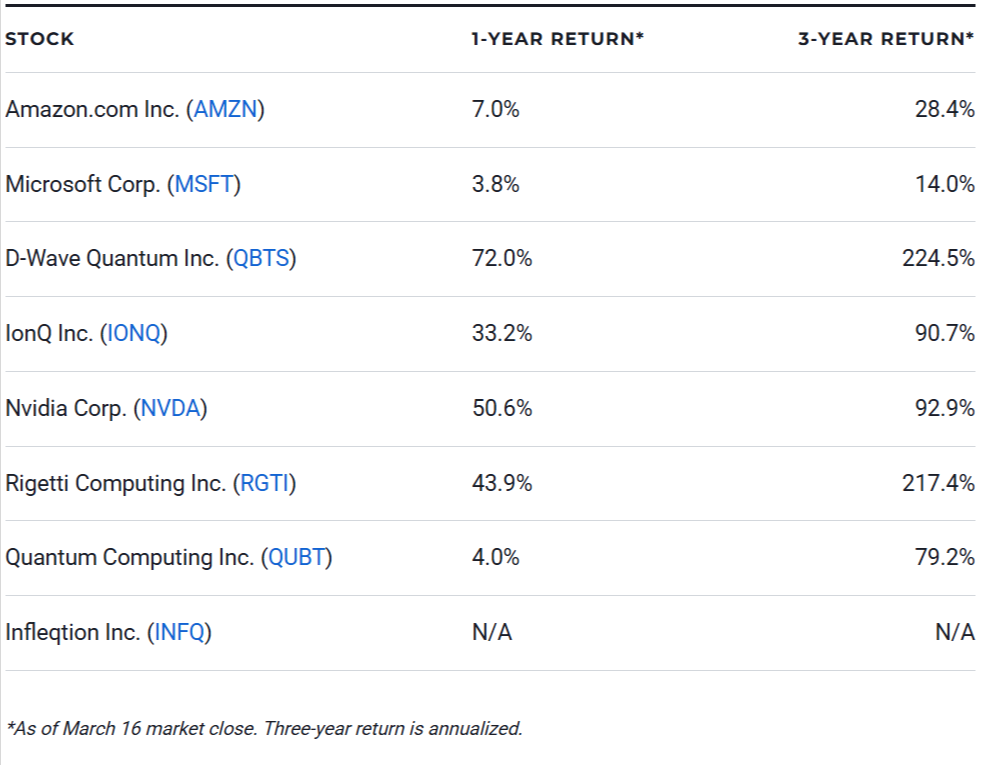
So where does that leave quantum computing investors right now? Pretty much in the same spot as a year ago, when the technology started to produce commercially and generate significant market interest. One year later, the same dynamic is in play, with the following stocks attracting the most interest right now:
STOCK
Amazon.com Inc. (AMZN)
Microsoft Corp. (MSFT)
D-Wave Quantum Inc. (QBTS)
IonQ Inc. (IONQ)
Nvidia Corp. (NVDA)
Rigetti Computing Inc. (RGTI)
Quantum Computing Inc. (QUBT)
Infleqtion Inc. (INFQ)
Amazon.com Inc. (AMZN)
It doesn’t get much attention, but Amazon runs its own stock portfolio, and lately, it’s leaning into the quantum computing sector. Exhibit A is IONQ, which Amazon holds in its investment portfolio as of December 2025. Though it recently re-established its position, the company owns 6,700 shares of the stock, valued at $299,000. By comparison, Rivian Automotive Inc. (RIVN) comprises 88.4% of the portfolio, but its IONQ stake shows that Amazon’s commitment to quantum computing goes beyond its own commercial quantum ventures.
Leading that list is the AWS Center for Quantum Computing, which includes research partnerships with academic leaders like the California Institute of Technology and its prototype quantum chip project (Ocelot), a superconducting quantum computing chip that both parties are designing. The chip project, rolled out last February, is already turning heads in the quantum space, with the chip curbing correction overhead by 90% and setting new standards for quantum computing error correction.
Trading down 8.3% year to date, AMZN still has its backers. Justin Post, an analyst at BofA, holds a “buy” rating on the stock with a $275 price target, citing the company’s expanded profit line, which includes a rebranding of the Prime Video plan that will boost the subscription price from $2.99 per month to $4.99. That move alone should add $780 million to Amazon’s coffers this year.
Microsoft Corp. (MSFT)
Down a rough 17.1% so far in 2026, Microsoft doesn’t look like it’s priming the pump anytime soon. Yet market analysts say MSFT is victimized by a major software slump that should abate as AI becomes a net positive for the company, given its acumen in key areas like application development, security, and direct access to key commercial sectors like gaming and social media. Microsoft is trading at a nine-month low, down 28% in that period, but should rebound if revenues leap 16% and earnings per share rise by 21% in the current fiscal year, as expected.
Microsoft should also make a significant mark in quantum chips. Zulfi Alam, Microsoft’s corporate vice president of Quantum, recently said he expects the company to have quantum-based products and machines in place by the end of the decade, which should generate significant returns. The company should excel especially in the hyperscaler realm, where tech outfits provide expanded computing capacity to produce quantum products and services.
D-Wave Quantum Inc. (QBTS)
Palo Alto, California-based D-Wave continues to lose ground with its share price down 33.2% so far in 2026. The deficit took QBTS shares to a 72% gain over the past year, down from a 203% gain only a few weeks ago. D-Wave executives sought to counter the bad news with encouraging numbers in a March 10 Q4 earnings call; company leaders noted fiscal year 2025 revenue of $24.6 million, a 179% increase from $8.8 million one year earlier, indicating that customers approve of what QBTS is doing. That’s particularly true in the hardware realm, with $16.2 million coming from system sales.
The company is also equipped with deployable cash and securities, giving D-Wave a much-needed sheen of financial stability. Additionally, D-Wave has garnered $800 million from investors, which will give QBTS a clear operational glide path going forward.
Consequently, don’t expect D-Wave’s share slide to last too long. Analysts covered by TipRanks’ rating tables set an average price target of $37 per share, which translates to a 113% increase in share price. Yes, companies like D-Wave are considered to have more upside potential, but they also carry greater pricing risk. So far, that’s worked out well for QBTS investors. If you’re looking for a big quantum winner in 2026, it’s companies like QBTS that offer the most upside risk-reward.
IonQ Inc. (IONQ)
Las Vegas-based IonQ’s share price has slid 2.4% over the past month and is now down 25.8% year to date. Some market experts point to rising oil prices linked to the U.S.-Iran conflict, which historically hurt energy-dependent sectors like quantum computing, making them more susceptible to higher-inflation environments.
The news on the ground seems upbeat, with IonQ inking a pact with the University of Cambridge for a joint quantum computing hub. The company is also tightening ties with the U.S. Air Force on public quantum computing programs geared toward defense issues, especially in the areas of protecting data and guarding access to chips and cloud platforms in quantum computing. Earnings per share and revenues are also expected to rise on a year-over-year basis.
IonQ has been busy on the acquisition front, buying up chip manufacturer SkyWater Technology for $1.8 billion. The move comes on top of recent purchases of the quantum performance company Oxford Ionics, the satellite firm Capella Space and the quantum sensor company Vector Atomic, all within the past year or so. The acquisitions are part of the company’s strategy to build a full stack of quantum offerings in software, hardware and applications to better compete in the quantum computing space, and to better position itself for ample U.S. government funding.
Ethan Ho, chief analyst at BTCC, a Hong Kong-based cryptocurrency exchange, said he favors IonQ as a pure-play innovator. “Its trapped-ion architecture avoids some of the massive cooling requirements of competitors, and their enterprise cloud partnerships are solidifying recurring revenue,” Ho notes.
Nvidia Corp. (NVDA)
Nvidia has positioned itself strategically in the quantum computing world, touting its hybrid quantum-classical computing ecosystem as a bridge between traditional high-level computing technology and quantum hardware systems.
That hybrid quantum computing approach is particularly effective with Nvidia’s NVQLink, an open system architecture that tightly couples the extreme performance of GPU computing with quantum processors to build accelerated quantum supercomputers, which launched on Oct. 28.
To no one’s surprise, Nvidia has a big advantage over pure-play quantum companies, delivering a triple dose of stability with solid earnings growth, stellar cash flow, and a top-tier position in AI chips, making it a reliable core stock for the long haul. That’s a smart play, given that the global quantum computing marketplace is expected to grow from $3.5 billion in 2025 to $20.2 billion by the end of the decade.
Trading at $183 per share in mid-March, most Wall Street analysts see green lights ahead for the stock, with analysts followed by TipRanks forecasting a consensus $274.46 share price over the next year. That’s a 50.8% upside potential for NVDA shares.
Rigetti Computing Inc. (RGTI)
Trading at $16 per share and down 27% year to date, Berkeley, California-based Rigetti continues its 2026 downslide. Fourth-quarter adjusted earnings didn’t help, as RGTI reported an adjusted loss of 3 cents per share and revenue of $1.9 million, which proved underwhelming versus analyst forecasts calling for $2.3 million in revenue.
Rigetti, which provides full-stack quantum computing services primarily for global enterprise, government and research clients via its Rigetti Quantum Cloud Services platform, remains bullish going forward.
“For the next few years, we expect much of our revenue to be generated from development contracts and anticipated sales,” the company stated in an annual filing with the U.S. Securities and Exchange Commission. RGTI already has at least $5.7 million in new orders teed up for the first quarter, including a profitable delivery of a new Novera quantum processor from a Japanese client, the company noted.
“These deployments underscore Rigetti’s role as a long-term technology partner supporting hybrid classical-quantum computing,” company CEO Subodh Kulkarni said in an early March statement. Recent insider sales by Chief Financial Officer Jeffrey Bertelsen and Chief Technology Officer David Rivas totaling over $700,000 haven’t helped matters, but TipRanks’ analysis pegs RGTI’s price target at about $35 per share, with a hefty 117% potential upside based on stronger order flow, a winning technology and sturdy cash flow.
Quantum Computing Inc. (QUBT)
Hoboken, New Jersey-based Quantum Computing has lost 28.2% in value in 2026 so far. Yet QUBT is showing signs of stability through its quantum-security product showcase. Recently, Quantum hosted a successful safe data links testing review with Ciena Corp., which saw the latter’s Waveserver system guard data at up to 1.6 terabits per second, using mandated post-quantum tools.
Additionally, QUBT is making significant strides in quantum error reduction. In a separate, recent testing session featuring QUBT’s Helios trapped-ion chip, the results showed that system error rates were 100 times lower than those of the chip’s raw qubits, suggesting greater safety in more complex quantum computing processes going forward.
QUBT shares could benefit from the company’s $110 million acquisition of Luminar Semiconductor Inc. in early February. The buyout should solidify its position in the photonics sector by integrating Luminar’s LiDAR technology to boost its quantum optics and photonics operations, an area of particular expertise for Luminar. Quantum Computing is a strong proponent of photonic chips, which it says will revolutionize the quantum computing industry.
The deal should make the company “screen better for investors,” says Rosenblatt Securities analyst John McPeake in a new research note. He sees a $22 share price in the next year, representing a whopping 197% upside. He’s not alone. Ascendiant tech analyst Edward Woo is also bullish on the stock, calling for a $25 price target.
Infleqtion Inc. (INFQ)
Trading at $11 per share and down 9.5% so far in 2026, Louisville, Colorado-based Infleqtion, which recently went public after a merger with Churchill Capital, a special purpose acquisition company, is nevertheless showing serious signs of growth potential. Infleqtion specializes in quantum computing based on neutral atoms, particularly cold-atom arrays that work in tandem with quantum sensing and networking technologies. That makes INFQ the first-ever neutral-atom quantum technology stock, representing a ground-floor opportunity for growth investors looking to catch some lightning in a bottle.
The company made news this week with the rollout of the U.K.’s first-ever 100-physical-qubit quantum computer, housed at the National Quantum Computing Centre.
“The NQCC’s quantum computing testbed is among the first of its kind, advancing innovation at a global level,” says Matthew Kinsella, CEO of Infleqtion, in a March 15 statement. “This latest achievement with Sqale (INFQ’s quantum computing platform) reflects the progress and potential of our neutral-atom architecture and marks an important step toward larger-scale quantum systems.”
Cresting the 100-physical-qubit level is “an important step beyond laboratory prototypes toward quantum computers that can run more complex algorithms, test error-correction approaches and support practical solutions,” the company noted. “At this scale, quantum systems begin to support experimentation that connects more directly to real-world challenges.”
The company is linking arms with the right partners as well. INFQ just announced it’s working with Nvidia’s NVQLink to showcase accelerated quantum supercomputing integration into modern data centers at Nvidia GTC 2026 this week in San Jose, California.
Dig Deep to Win With Quantum Stocks
With quantum computing still in its relative infancy, it’s too early to crown an easy winner, but industry experts offer some tips for success:
Use a ‘Picks and Shovels’ Strategy
“If anything, the more rational strategy is to look at the infrastructure layer, like cooling systems, precision electronics, advanced materials and quantum-safe cybersecurity,” says Arie Brish, a former CEO and now an adjunct professor at the Bill Munday School of Business at St. Edward’s University. “This is called metaphorically ‘shovel strategy,’ borrowed from the gold rush days. Don’t be a gold miner; rather, sell shovels to the gold miners. History shows that in emerging business waves, the ‘shovel suppliers’ often outperform the prospectors.”
Stick With Blue-Chip Tech Stocks
Another strategy could be to invest in legacy technology companies, most of which are conducting solid quantum research. “Here, however, you’ll be diluted by the performances of all their other businesses,” Brish says. “If they won’t have a successful outcome from their own lab, they’ll most likely buy a later-stage and proven quantum technology company.”
Diversify With ETFs
If the quantum industry’s recent underperformance is holding you back, Ho advises spreading the risk with the Defiance Quantum ETF (QTUM) as a standout choice. “It effectively dilutes the bankruptcy risk inherent in early-stage QC startups by providing diversified exposure across the entire global supply chain, including the vital semiconductor firms manufacturing the underlying hardware,” he says.
Test Your Strategy
Additionally, investors new to the quantum arena should treat quantum stocks as high-volatility, frontier assets. “You must master risk management before chasing gains,” Ho adds. “Beginners should always test their strategies in simulated environments first.”
Doing so is worth the effort. “Quantum computing is a massive, decade-long supercycle,” Ho says. “The smartest retail strategy for 2026 is using ETFs for baseline exposure, while utilizing simulated trading to safely learn the behavioral volatility of pure-play stocks.”
