The continuing conflict between the U.S. and Iran has sent oil prices above $100 a barrel for the first time since Russia’s 2022 invasion of Ukraine roiled global energy markets.
The supply shock comes amid Iran’s blockade of the Strait of Hormuz, a key chokepoint for global oil exports, in retaliation for U.S.-Israeli strikes. Skyrocketing oil prices have raised fears about inflation and helped push down global stocks. One exception is oil producers.
Commodities in general are often considered inflation hedges because their use goes up during times of heightened economic activity. In this case, the inflation hedge comes as a direct result of the rise in a single commodity that may ultimately weigh on economic activity.
For now, oil producers are benefiting from war in the Middle East, with the State Street SPDR S&P Oil & Gas Exploration & Production ETF (ticker: XOP) up nearly 7% as of the March 6 close since the U.S.-Israel strikes on Iran. The exchange-traded fund is up nearly 30% year to date by market price.
“Combat in the Middle East and high risk in the Strait of Hormuz are top of mind right now,” says John Bocock, a portfolio manager at Pinnacle Associates. “The effect of higher oil prices on inflation expectations around the world is important.”
Still, there are risks, as oil prices are notoriously volatile. The global oil market is generally oversupplied, and any opening of the Strait of Hormuz would likely send prices falling fast.
“Investors should be mindful of generally plentiful oil supply and the prospects for a sudden reduction in geopolitical risk,” Bocock says.
Meanwhile, the conflict in Iran has also crimped supply of liquefied natural gas shipped through the Strait of Hormuz. And major exporter Qatar has stopped exports, helping cause a spike in natural gas prices in Europe and Asia.
Should You Invest in Natural Gas Now?
U.S. natural gas prices have been largely unaffected because of domestic production, high storage levels and a move toward warmer temperatures that require less natural gas for heating.
But exports to Europe and Asia are a key reason to invest in natural gas. Natural gas prices in those regions, even before the latest Iran conflict, are typically much higher than those in the U.S., prompting companies to invest in large plants to chill the commodity for export by sea.
Natural gas is also expected to play a key role in powering data centers that require massive amounts of electricity to run computers that crunch numbers for artificial intelligence calculations.
“The single biggest bottleneck to AI is access to power, and the only near?term scalable solution is natural gas-fired generation, making gas central to powering data centers and AI infrastructure,” says Andrejka Bernatova, CEO of Dynamix Corp. (OTC: DNMXU), a holding company that pursues deals in the energy, power and infrastructure sectors.
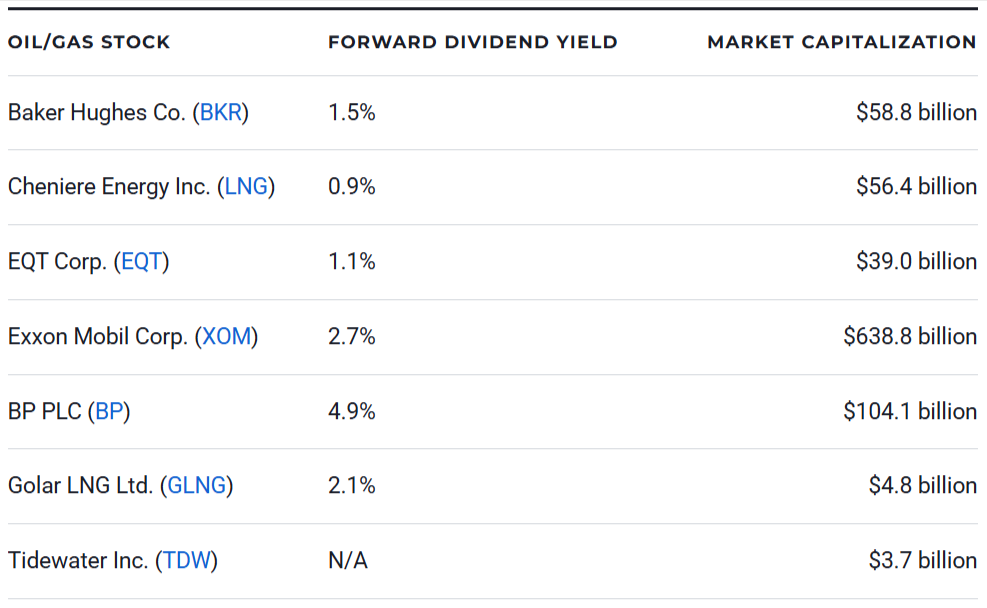
With that in mind, here’s a look at seven top oil and natural gas stocks to buy now:
Oil/Gas Stock
Baker Hughes Co. (BKR)
Cheniere Energy Inc. (LNG)
EQT Corp. (EQT)
Exxon Mobil Corp. (XOM)
BP PLC (BP)
Golar LNG Ltd. (GLNG)
Tidewater Inc. (TDW)N/A
Baker Hughes Co. (BKR)
Rob Spivey, director of research at financial research firm Altimetry, is favoring natural gas and oilfield services companies such as Baker Hughes.
“There’s a reason we’re steering clear of oil stocks,” he says. “They’ve got both upside and downside risk right now, as their moves are entirely tied up in geopolitics currently. It’s going to create a lot of volatility.”
But the natural gas and services companies he is focusing on, such as Baker Hughes, have structural tailwinds behind them, he says.
“Like other services giants SLB and Halliburton, they benefit from energy companies wanting to punch more holes in the ground with higher energy prices,” he says. “They also are the partner LNG companies rely on for the complex equipment they need to compress and decompress natural gas.”
Cheniere Energy Inc. (LNG)
Within the natural gas space, a superchilled version of the fuel, or liquefied natural gas, has helped transform the industry into a global market.
That’s because natural gas in its liquid form is much easier and more economical to transport by ship, opening up Asia and Europe to natural gas produced cheaply in the U.S. The U.S. is the biggest natural gas-producing country in the world and has increased in importance as an exporter of LNG, especially as Europe tries to free itself from Russian energy amid the war in Ukraine.
Cheniere Energy has one of the largest natural gas liquefaction platforms in the world, with facilities in Louisiana and Texas.
“They’ve been the leader in standing up LNG export capacity for the U.S., and they have significant … plans for LNG export capacity expansion,” Spivey says. “Higher prices, higher demand and higher capacity all spell reasons for further earnings upside for LNG.”
EQT Corp. (EQT)
This company is a top U.S. natural gas player, with operations in the Marcellus and Utica shales of the Appalachian Basin.
The company is benefiting from increased U.S. demand from artificial intelligence data centers and the broader expansion of U.S. power production, Spivey says.
EQT is also benefiting from increased LNG exports to Europe and Asia as they look to import from more secure sources than Qatar (which is dependent on the Strait of Hormuz) or Russia, he adds.
Exxon Mobil Corp. (XOM)
Turning to large energy investment staples, this oil and gas supermajor often makes the list of experts’ top picks for oil and gas stocks. Like other Big Oil companies, supermajors are vertically integrated, meaning they own the entire supply chain, from exploring for hydrocarbons, getting oil and gas out of the ground and refining it, to transporting it and selling it to end consumers.
When it comes to the renewable energy transition, Exxon has deep pockets to spend on new technologies. It has dabbled in carbon capture and storage, hydrogen, lower-emission fuels and lithium, a key mineral for electric vehicle batteries and grid storage.
Still, all of the supermajors remain oil and gas companies at heart, as they try to balance the push for decarbonization with continued demand for their core fossil fuel products.
BP PLC (BP)
There is a real risk of shareholder backlash against Big Oil companies leaning too far into renewables. For example, activist investor Elliott Management has said BP has been poorly managed in recent years. Some say it delved too far into clean energy at the expense of its bread and butter, which is oil and gas. But that is changing, as the company has announced cuts to renewable energy investments and a boost to spending on oil and gas.
This is one of the biggest oil and gas companies in the world. It is vertically integrated, and its size, business mix and geographic diversification lend the company stability, but also mean BP isn’t likely to grow as fast as a smaller exploration and production company could.
Golar LNG Ltd. (GLNG)
Here’s another, albeit much smaller, play on the natural gas theme. This company, which designs, owns and operates marine infrastructure for turning natural gas into LNG, provides key services for the liquefied natural gas industry.
The company has been busy exiting its LNG shipping business to focus on floating infrastructure that turns natural gas into liquid and, on the other end, infrastructure that turns LNG back into gas and stores it.
Tidewater Inc. (TDW)
This company operates vessels that support the global offshore energy industry, offering another play on the potential for offshore oil and gas exploration and production.
The company has also invested in offshore wind services, but not to the extent of some of its competitors. Still, the offshore wind industry in Europe and Asia is much more advanced than in the U.S., and Tidewater’s global presence could provide the company with room to expand.
But for now, Tidewater is much more focused on the oil and gas industry. It’s one of the small- and mid-cap companies Bocock likes, along with Golar, Antero Resources Corp. (AR), NPK International Inc. (NPKI) and Solaris Energy Infrastructure Inc. (SEI)。
“In general, these are small- and mid-cap companies with company-specific catalysts and attractive fundamentals,” Bocock says. “We believe these companies have good prospects even if oil and natural gas prices flatten or decline modestly.”
