The effects of the recent U.S. and Israeli strikes that killed Iranian Ayatollah Ali Khamenei and much of the country’s military and nuclear leadership have not been confined to the three direct belligerents.
In retaliation, Iran targeted a number of U.S. military and intelligence assets located across neighboring Gulf states, including Bahrain, Kuwait, Qatar, Saudi Arabia and the United Arab Emirates.
Many of these countries host American military bases, defense infrastructure and logistics hubs. Their close security cooperation with Washington has long made them strategic partners of the U.S. and, in Tehran’s view, legitimate targets during escalation.
However, as of March 7, Iran has signaled a potential shift in doctrine. Current Iranian President Masoud Pezeshkian stated that Iran would no longer target neighboring countries, unless attacks on Iran were launched directly from their territory.
That statement helped calm immediate fears of a wider regional war, though tensions remain elevated. The conflict has already had significant consequences for global markets, particularly energy flows through the Strait of Hormuz, a chokepoint responsible for roughly a fifth of global oil shipments.
“I don’t think the war with Iran is necessarily bearish for the stock market, but it’s going to create a lot of volatility and dislocations, making it very difficult to make active investment decisions,” says Matthew Tuttle, CEO at Tuttle Capital Management.
Beyond commodities, the geopolitical turmoil has also spilled into a relatively niche corner of financial markets: country-specific exchange-traded funds (ETFs)。
While ETFs are widely used for international diversification, most investor flows typically go into broad regional products tracking benchmarks such as EAFE, which covers Europe, Australasia and the Far East, or large emerging market blocs including countries such as Brazil, India and China. These diversified funds spread exposure across dozens of markets rather than concentrating risk in one.
In periods of geopolitical stress, however, traders often seek more targeted vehicles to express specific macro views. Country-specific ETFs provide a way to do exactly that, allowing investors to isolate exposure to individual markets without directly buying local securities.
They can also be used tactically: Investors may take bullish positions, hedge regional risk with options or even bet against certain markets through short selling.
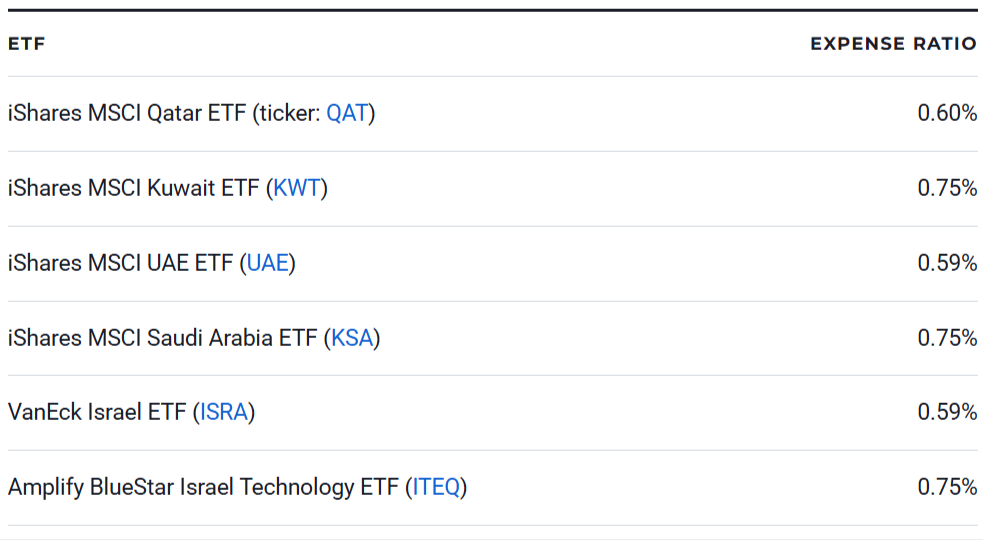
Here are six of the best Middle East ETFs to buy in 2026:
ETF
1.iShares MSCI Qatar ETF (ticker: QAT)
2.iShares MSCI Kuwait ETF (KWT)
3.iShares MSCI UAE ETF (UAE)
4.iShares MSCI Saudi Arabia ETF (KSA)
5.VanEck Israel ETF (ISRA)
6.Amplify BlueStar Israel Technology ETF (ITEQ)
iShares MSCI Qatar ETF (QAT)
While Qatar may not immediately come to mind when people think of Gulf states involved in geopolitical flashpoints, it plays an important strategic role as host to Al Udeid Air Base, one of the largest U.S. military installations in the region. During the current conflict, an Iranian strike reportedly hit the base but caused no casualties. For investors, the Qatari stock market has long been accessible via QAT.
QAT launched in April 2014 and currently holds about $70.7 million in assets under management (AUM)。 The ETF tracks the MSCI All Qatar Cap Index, a market cap-weighted benchmark of 33 Qatari equities. Like many country-specific Middle East ETFs, QAT’s portfolio is heavily concentrated in financials, which account for roughly 57% of assets, largely through domestic banks and financial institutions.
iShares MSCI Kuwait ETF (KWT)
One of the more unusual incidents early in the conflict occurred when three U.S. F-15E Strike Eagle fighter jets were downed by friendly fire over Kuwait. The episode drew attention to the country’s long-standing strategic relationship with the U.S. Kuwait has maintained close defense ties with Washington since the 1991 Gulf War, when a U.S.-led coalition expelled occupying Iraqi forces.
For investors seeking exposure to the Kuwaiti market, iShares launched KWT in September 2020. KWT tracks the MSCI All Kuwait Select Size Liquidity Capped Index, which holds 36 market cap-weighted stocks. The portfolio is heavily concentrated in financial institutions, though the tilt is even more pronounced here than in Qatar’s market, with financials making up about 70% of the portfolio.
iShares MSCI UAE ETF (UAE)
The United Arab Emirates also drew significant attention during the conflict as images circulated of foreign expatriates attempting to flee the country amid fears of drone strikes. Despite these risks, the UAE remains one of the most attractive destinations for expatriates. This is largely thanks to the UAE’s tax-friendly policies, modern infrastructure and reputation as a Middle East financial and logistics hub.
That international appeal is reflected in the size of UAE, which has $212 million in AUM. Compared to QAT and KWT, financial sector dominance is less pronounced, at about 37% of the portfolio. Instead, UAE has a larger allocation to real estate at 22%, reflecting the country’s property development sector and the central role of construction, tourism and commercial real estate in its economy.
iShares MSCI Saudi Arabia ETF (KSA)
Energy markets were further rattled when drones reportedly targeted Saudi Aramco’s Ras Tanura refinery and export terminal, one of the largest oil processing and shipping facilities in the world. The incident served as a reminder that global energy markets are influenced not only by Western oil supermajors, but also by several large, state-linked producers domiciled in the Middle East.
Investors can gain exposure to Saudi Aramco and more through KSA, which passively tracks the MSCI Saudi Arabia IMI 25/50 Index. The ETF includes over 120 other companies listed on the Saudi exchange. As is typical for Gulf markets, financials dominate the portfolio at about 42%, though natural resources remain a major component, with roughly 15% allocated to materials and 12% to energy.
VanEck Israel ETF (ISRA)
“ISRA seeks to replicate the performance of the BlueStar Israel Global Index, which is comprised of equity securities, of publicly traded Israeli companies listed in Tel Aviv and globally,” explains Steven A. Schoenfeld, CEO at MarketVector Indexes. “The ETF provides exposure to Israel’s stable and resilient economy with a history of consistent GDP growth, even during times of geopolitical risk.”
While still financials-heavy, ISRA’s sector composition has a more substantial allocation to technology and health care companies, along with a number of notable defense firms from the industrials sector, such as Elbit Systems Ltd. (ESLT)。 “ISRA delivered a strong 37.5% return in 2025 and an impressive 10% return in 2026 to date,” Schoenfeld says. The ETF charges a 0.59% net expense ratio.
Amplify BlueStar Israel Technology ETF (ITEQ)
“ITEQ offers investors targeted exposure to Israel’s globally influential technology ecosystem, including companies driving innovation in areas like cybersecurity, autonomous driving, artificial intelligence, clean technology, defense technology and 3D printing,” says Christian Magoon, founder and CEO at Amplify ETFs. Compared to ISRA, ITEQ is narrower in scope and lacks a financial sector overweight.
ITEQ’s benchmark, the BlueStar Israel Global Technology Index, leans heavily into technology sector equities at a 67% allocation. Notable holdings include Check Point Software Technologies Ltd. (CHKP), a leading cybersecurity company known for enterprise network and cloud security solutions. The ETF also holds Tower Semiconductor Ltd. (TSEM), which manufactures specialized analog components.
